October 15, 2026
•
Master Data & Duplicates
•
Philipp Descovich
A Spare Parts Naming Convention Is Five Rules and an Order
A spare parts naming convention is five rules and an order to apply them in, and the order matters more than the rules. Here they are, built on one pneumatic cylinder, with the way to apply them to the catalog you already have.
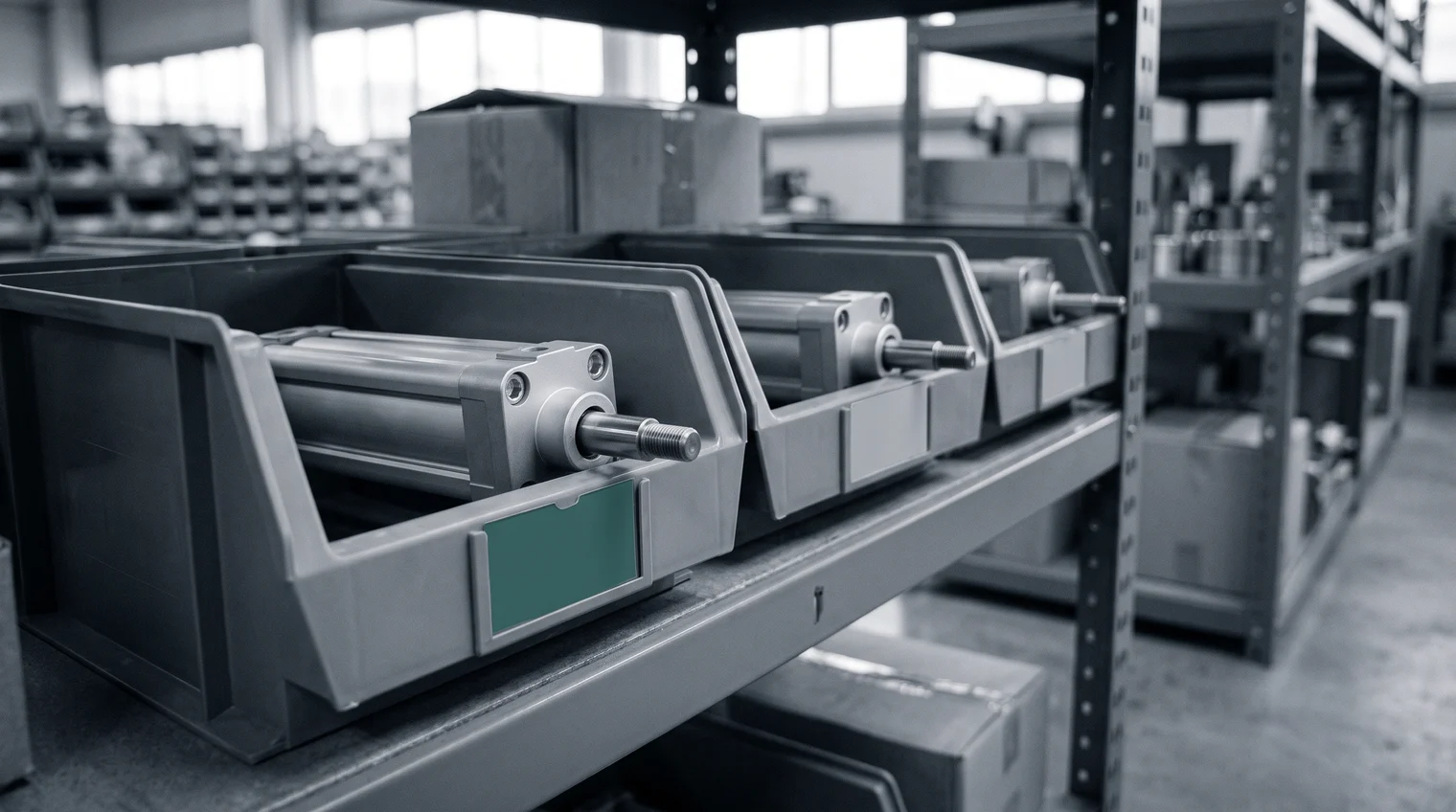
A maintenance planner asks for a pneumatic cylinder, bore 50 mm, stroke 200 mm, to replace one that has started leaking on a palletiser. The storeroom holds that cylinder at three plants, under five records, and no two of the five names start with the same word. The buyer searches for "pneumatic cylinder 50", finds nothing that looks right, and orders one from the dealer as a free-text item. The cylinder was in the catalog the whole time. Its names hid it.
Names drift because many people write them over many years
A material master is written by many hands. A storeroom clerk creates a record during a shutdown, a buyer creates one from a dealer's quote, and a project engineer loads a batch from a machine builder's spare parts list. Each of them writes in the shorthand of their plant, their language and their week. In SAP, the material description they type, the short text, holds 40 characters, so words get cut where the typist ran out of room. The cut lands somewhere different every time.
No single record looks wrong when you open it. The damage shows only across the catalog, where the right part often exists somewhere and still cannot be found. How a keyword search fails on such records is the subject of why spare parts search in the material master misses parts. This post goes one step earlier, to the names themselves.
A name nobody can search has a price. The part is bought again, or created again as a new record, and the storeroom carries stock it cannot see. That is one of the hidden costs of poor spare parts master data, and it grows with every record added in someone's own shorthand. Practitioners who have rebuilt a storeroom describe the fix from the shelf: once descriptions follow one standard, noun first, the storeroom can see what it already holds, including a part that will do the job of the one it is missing.
One pneumatic cylinder, five records
Take the palletiser's cylinder: an ISO 15552 pneumatic cylinder, double-acting, bore 50 mm, stroke 200 mm. Here is how it reads across three plants.
Plant 1000 knows it as 10004812, short text CYL PNEU 50X200 DA ISO, an abbreviation in capitals that someone found efficient. Plant 2000, in Germany, has 20003391, PNEUMATIKZYLINDER D50 HUB 200, which is correct and readable to anyone who knows that Hub is the stroke. Plant 2000 also has 20008150, created later by an English-speaking engineer, CYLINDER 200MM STROKE 50MM BORE, with the stroke first. Plant 3000 has 30001247, a short text of one word, CYLINDER, and a dealer's catalogue number where the manufacturer part number should be. An older record at plant 1000, 10017733, has the manufacturer part number typed into the short text itself, CYLINDER PNEUM AC5-50-200-DM-A1 DOUBLE A, and the field ends there, at the fortieth character, in the middle of "acting".
Each record was right for the person who typed it. Together they make one part look like five, and a buyer who finds one of them has no reason to think the other four exist. The part numbers in this example are the illustration's own.

A spare parts naming convention is five rules in a fixed order
The convention that fixes this is short enough to fit on one page per class. Applied in this order, five rules give every record in a class the same shape:
- The noun first, from a fixed list of nouns. One noun for each kind of part, singular and in full: CYLINDER, never CYL or ZYL. The master data team keeps the list, and a new noun is added by the team, not by whoever creates the record.
- Then the type. The word that separates this cylinder from other cylinders: PNEUMATIC, HYDRAULIC. Cataloguers call this pair of noun and type the noun-modifier format.
- Then the attributes that decide fit, in a fixed order per class, with fixed units and abbreviations. For pneumatic cylinders that order is bore, stroke, action and standard, written D50, S200, DA, ISO15552, in millimetres every time.
- The manufacturer and its part number in their own fields, never in the short text. In the short text they take the room the attributes need, and they hide from anyone who searches the fields built for them.
- One language in the short text. Translations go in the language fields the ERP keeps for each material description.
The order matters more than any single rule. A short text is read from the left, and a list of records is sorted from the left, so when every record in a class starts with the same noun and lists its attributes in the same order, the records of one part land next to each other and their differences show. The order also decides what gets cut. A short text that runs out of room loses its end, so the attribute that matters least for fit goes last.
Built by the rules, the palletiser's cylinder reads CYLINDER,PNEUMATIC,D50,S200,DA,ISO15552, 39 characters. Everything else the buyer or the technician needs goes to the long text and the attribute fields: the cushioning, the magnetic piston for the position sensors, the piston rod thread, the port size, and the manufacturer and its part number in the fields made for them. Some large operators go one step further and generate the short text from each class's attribute list, so nobody types it at all. Your own classes come first in that work. A standard classification such as eCl@ss can be mapped onto them later, when a partner or a tender asks for it.
Apply the convention class by class, new records first
Renaming a whole material master by hand is the project nobody funds, and it would be out of date before it finished. The convention goes in class by class instead, starting where the storeroom and the buyers search most, because those names are read the most. Every new record follows the convention from its first day, so the classes you have fixed stay fixed. Renaming also brings records to the surface that turn out to be one part: two records that end up with the same name are a duplicate candidate, which is where finding duplicates in the material master takes over.
Partium Cockpit works on both halves of that order, and your team decides every name that changes. New records start on the right footing. No duplicates, no half-empty records: every new part enters the catalog complete. Behind each name sit the attributes the convention asks for. Data Enhancement Monitor proposes the missing attributes for each part your team adds. The name itself follows the same logic. With Uniform Naming, in Beta, it names every part the same way, so the same part always reads the same. The classes you have not reached yet still have to be found in the meantime. Until every name is fixed, Material Search forgives typos and the many ways one part gets written.
Start this week with one class. Take the class your storeroom searches most, write down its noun, its type and its attribute order, and rename twenty of its records by hand. Count how many of the twenty turn out to be the same part. To apply the same convention on your own catalog, book a demo and see it on our demo catalog, or on a sample of your data.
See it on a catalog like yours.
We show you Partium live, on our demo catalog or on a sample of yours.