July 23, 2026
•
Procurement
•
Philipp Descovich
Why Parts Intelligence Is Becoming the Missing Layer Between Search, Sourcing, and Decision-Making
Most industrial companies have plenty of systems and plenty of spare parts data. What their sourcing and maintenance decisions lack is the part's full context at the moment someone has to decide, and that is the gap Parts Intelligence works in.
Walk through a mid-sized plant and count the systems that know something about its spare parts. The ERP holds the material master. The CMMS holds the work orders and the bills of materials. Procurement keeps a supplier portal and a folder of framework agreements, the storeroom has its bin labels, and one planner maintains a spreadsheet because the ERP never had the field she needed. Nobody in that plant is short of systems. What they are short of, at the moment a decision has to be made, is a complete picture of the part: the information exists, but it is incomplete in one place, scattered across three others and duplicated in a fourth.
The gap sits between spare parts data and the sourcing decision
For years the standard answer has been to treat this as a master data problem. Clean the descriptions, standardize the naming, merge the duplicates, and better decisions will follow. That work is worth doing, and it never finishes. The plant does not stop while the catalog is cleaned. A technician still has to name a part while a press stands still, and a buyer still has to place an order before the lead time runs out. Those decisions are made on the data as it is today, under time pressure, by people who cannot wait for a cleansing project to reach their part number.
So the gap that matters is the one between what a team knows about a part and the decision in front of it. The supplier record, the bill of materials, the nameplate and the part number are all there; the manufacturer's number, the other sources, a price reference and the stock at the next site usually are not. Closing that gap is the work of the category Partium calls Parts Intelligence, and it is easiest to see with one part.

One hydraulic cylinder, three teams, three records
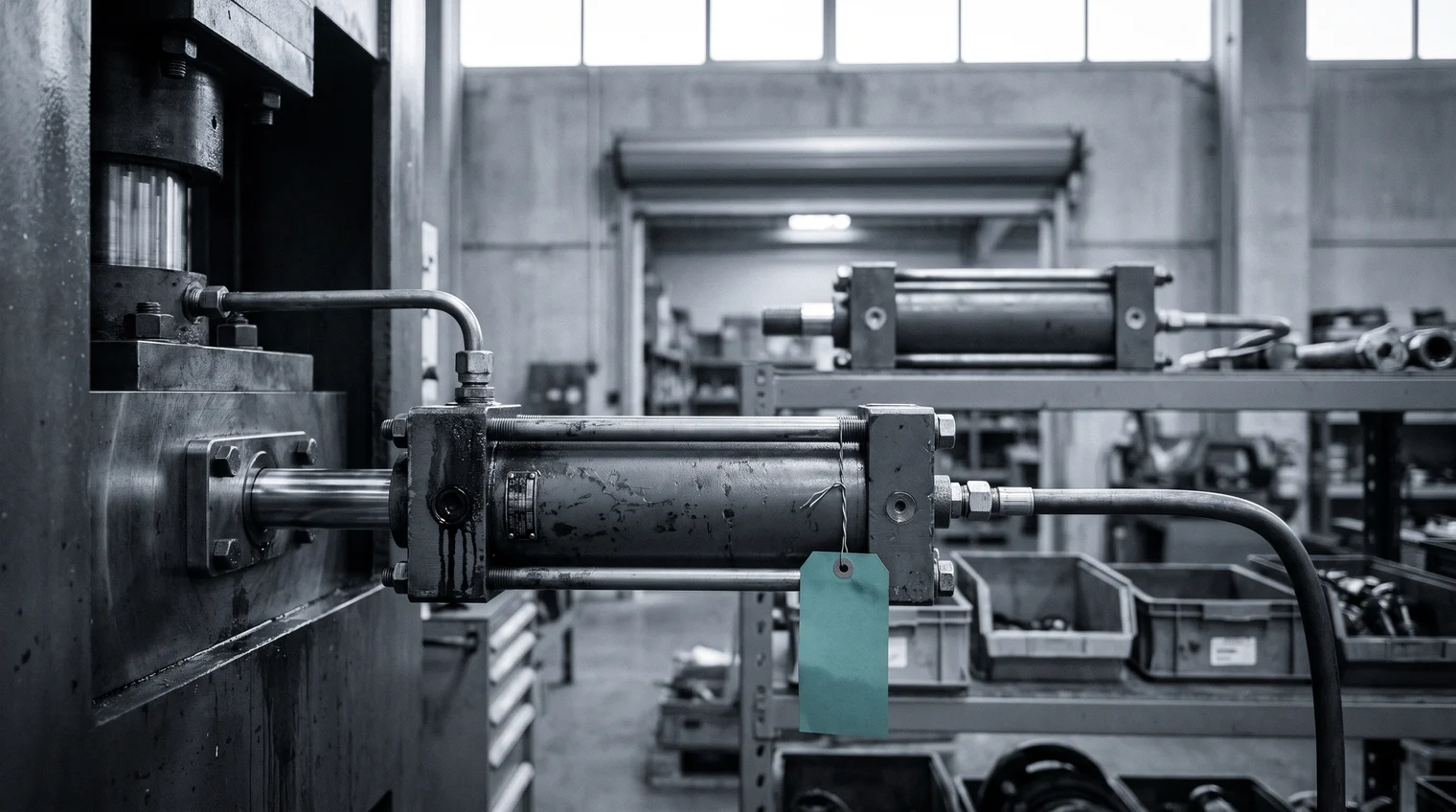
Take the hydraulic cylinder on the clamping unit of a press. In maintenance, it shows up as an oil leak and a nameplate that the oil has half wiped off. The technician knows the machine and roughly what the cylinder does, and needs to know whether the storeroom has one. In the ERP, the same cylinder may sit under a short text that says little more than "cylinder, hydraulic", with no manufacturer part number, and possibly under a second article number that someone created two years ago because the first one could not be found. The technician's side of this, and how long a repair waits on it, is the subject of why maintenance waits for the right part.
In procurement, the cylinder shows up as a requisition with a long OEM lead time. The buyer has the machine builder's number and price, and is asked whether anyone else makes the part. Without the original manufacturer's number, nobody can tell. At the machine builder, the same cylinder appears a third time, on the parts desk: a customer writes in with the machine's serial number and the words "the clamping cylinder is leaking", and the desk has to turn that into a part number and a quote by the afternoon.
Three people, one physical part, and each of them is missing a piece that one of the others may hold. Maintenance, procurement and the aftermarket touch the same part, and each sees a different record. Parts Intelligence works on the record underneath, so every team works from the same facts.
A Parts Intelligence layer has to work with what is there
The inputs to that layer are rarely clean, and pretending otherwise is how software projects stall. What a team has is a worn nameplate, a short text written in two languages by two different people, a dealer's number with no maker behind it, a purchase order from four years ago under another description, and the bill of materials of the press. A layer that only works once those inputs are tidy is a cleansing project with a new name.
To be useful, it has to start from whatever the person in front of the part has, and get from there to an identified part. It has to connect the records that describe that part, including the ones filed twice. It has to bring in what the company does not hold itself: who else makes the part, and what it should cost. And it has to put the result in front of the person who decides, in a form they can check, because a buyer who cannot explain where a price came from will not use it in a negotiation. None of that replaces judgment. It changes what the judgment is based on, from what one person happens to remember to the same facts for everyone who touches the part.
The same facts for the technician, the buyer and the parts desk
Partium Parts Intelligence connects the technician at the machine with the teams who buy, stock and maintain your catalog. Partium Agent does the work beneath both products; Cockpit and Find put the answer in front of the person who decides. For the cylinder, the work splits along lines the plant already knows. Cockpit is where your team works on the catalog, the stock and the price. Partium Find is the separate product for identifying a part in the field.
The cylinder's own route is short to tell. Follow one part through the platform: Find identifies it at the machine, and Cockpit shows its duplicate candidates, what it should cost and when it is heading for obsolescence. The plant keeps every system it counted at the start of this post. Your ERP stays the system of record. Partium Agent reads from it and writes back what your team decides.
Book a demo and bring one of your own parts that has three records and three owners. If your work sits on one side of that part, the department posts on this blog go deeper.
See it on your own catalog.
Book a demo, or start with a demo license.