July 24, 2026
•
Maintenance & MRO
•
Philipp Descovich
Maintenance Doesn't Wait for Data. It Waits for the Right Part.
Many maintenance delays caused by spare parts begin before anyone picks up a tool: at the moment nobody can say which part it is, whether it is in stock, and who else sells it.
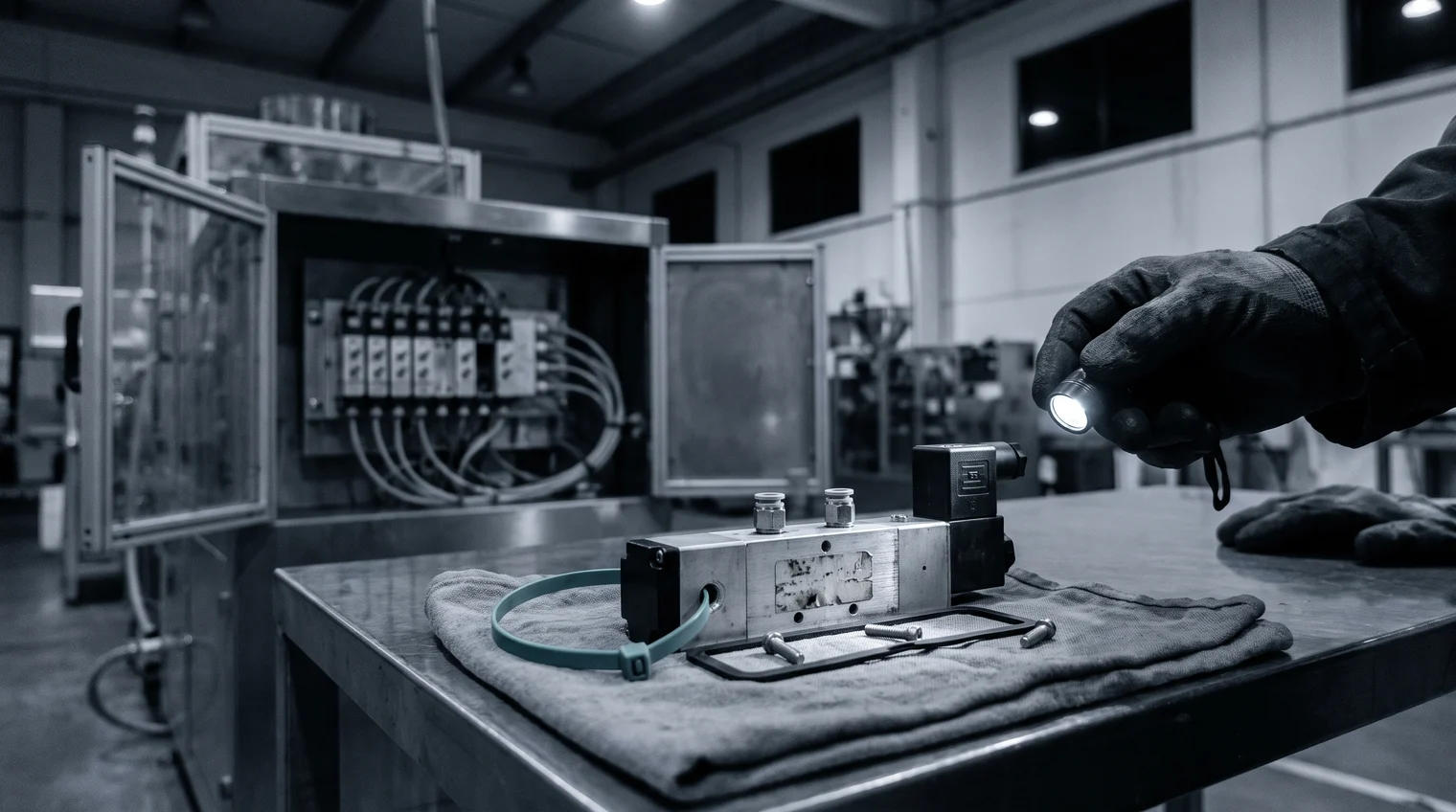
At ten past two in the morning, a form-fill-seal machine on a packaging line stops with a pneumatic fault. The technician on the night shift traces it to a solenoid valve in the valve block, removes it and puts it on the bench. Swapping the valve is a short job. The line stays down far longer, because nobody can say with certainty which valve it is, whether there is one in the storeroom, and where to get one if there is not.
Maintenance delays start at the spare part decision
When plants talk about MRO delays, the conversation usually turns to labor, capacity, schedules or a supplier who delivered late. All of those are real. The delay that is easiest to miss sits in between: the part decision, which has to be made before the repair can start. It is a small sequence of its own, and every step depends on the record behind the part.
- Identify the part from what is in front of you.
- Confirm that it is the right replacement for this machine.
- Check stock, in this storeroom and at the other plants.
- Find a source if there is none, and know what it should cost.
When the record is complete, these four steps take minutes and nobody notices them. When it is not, each one stalls in its own way. The label on the valve is worn and only half the type code is legible. The ERP search for "solenoid valve 24 V" returns a page of near matches with short texts that all look alike. The valve may be in stock under a second article number. And if it is not, the buyer has only the machine builder's number, with the machine builder's lead time attached.

The part may exist and still be hard to use
The frustrating thing about the night shift's valve is that the answer probably exists. The valve may be on a shelf two aisles away, filed under the description someone typed in 2019. The ERP may hold the original manufacturer's number on an old purchase order. The colleague who replaced the same valve last spring knows exactly which one it is, and is asleep. All of this information is real, and none of it can be used at two in the morning.
That is where maintenance time disappears: a worn label turns into a phone call, a short text turns into a long search, a second record turns into a second purchase, and a missing manufacturer number turns the buyer's search for another source into guesswork. The buyer's side of that last step, and why it so often ends at the OEM, is the subject of why the OEM is often the only source you can see. For the maintenance team, the consequence is the same each time. The repair waits until the part decision is made, and for critical spares, the ones a line cannot run without, that wait is the downtime.
Parts availability is a wider problem
None of this is particular to one plant. IBM describes what it calls the MRO supply chain as the sourcing, procurement and management of the parts and equipment that keep industrial equipment running, and counts spare parts procurement, MRO inventory management and service coordination among its parts. In other words, the time a repair takes depends as much on the parts behind it as on the people doing it.
Aviation shows what that looks like when parts become scarce. In June 2026, IATA called for urgent action to ease engine MRO bottlenecks, naming engine durability issues, parts shortages, limited spare engines and constrained aftermarket access as the causes of disruption for airlines, and asking for better access to spare parts, more approved repair options, fair access to MRO capacity and more aftermarket competition. In a second release the same day, it called for better integration between airline maintenance systems and external market intelligence to improve inventory management, with AI in a supporting role, reducing the manual work in those processes. A plant's storeroom is not an airline, but the lesson carries over: when parts are hard to get, knowing exactly which part you need, where it is and who else has it decides how long the equipment stands still.
Each stalled step needs its own answer
Start with the worn label on the valve. Scan the label or nameplate, and Find returns results from the text on it. The technician still confirms the match against the valve in hand, and the decision stays with the person at the bench.
Then comes the question the storeroom could not answer at two in the morning. One search shows where the part is stocked, at every plant, so you find it before you buy it again. If no plant has the valve, the buyer needs a second source before the machine builder's lead time decides the matter. Supplier Discovery finds who else makes or sells the part, down to the OEM behind a dealer number. The valve's record should not stay as thin as it was that night, either. When a part's record is incomplete, you complete it in Partium Cockpit: Partium Agent proposes what is missing, and your team decides.
If your night shift knows the valve story, book a demo and bring one of the parts that held up a repair last month.
See it on your own catalog.
Book a demo, or start with a demo license.