October 9, 2026
•
Master Data & Duplicates
•
Philipp Begala
Why Keyword Search Misses Spare Parts in the Material Master
"It's not in the system" is one of the most common sentences in a storeroom, and often one of the least accurate. Spare parts search in the material master fails on how parts are written, not on whether they are there.
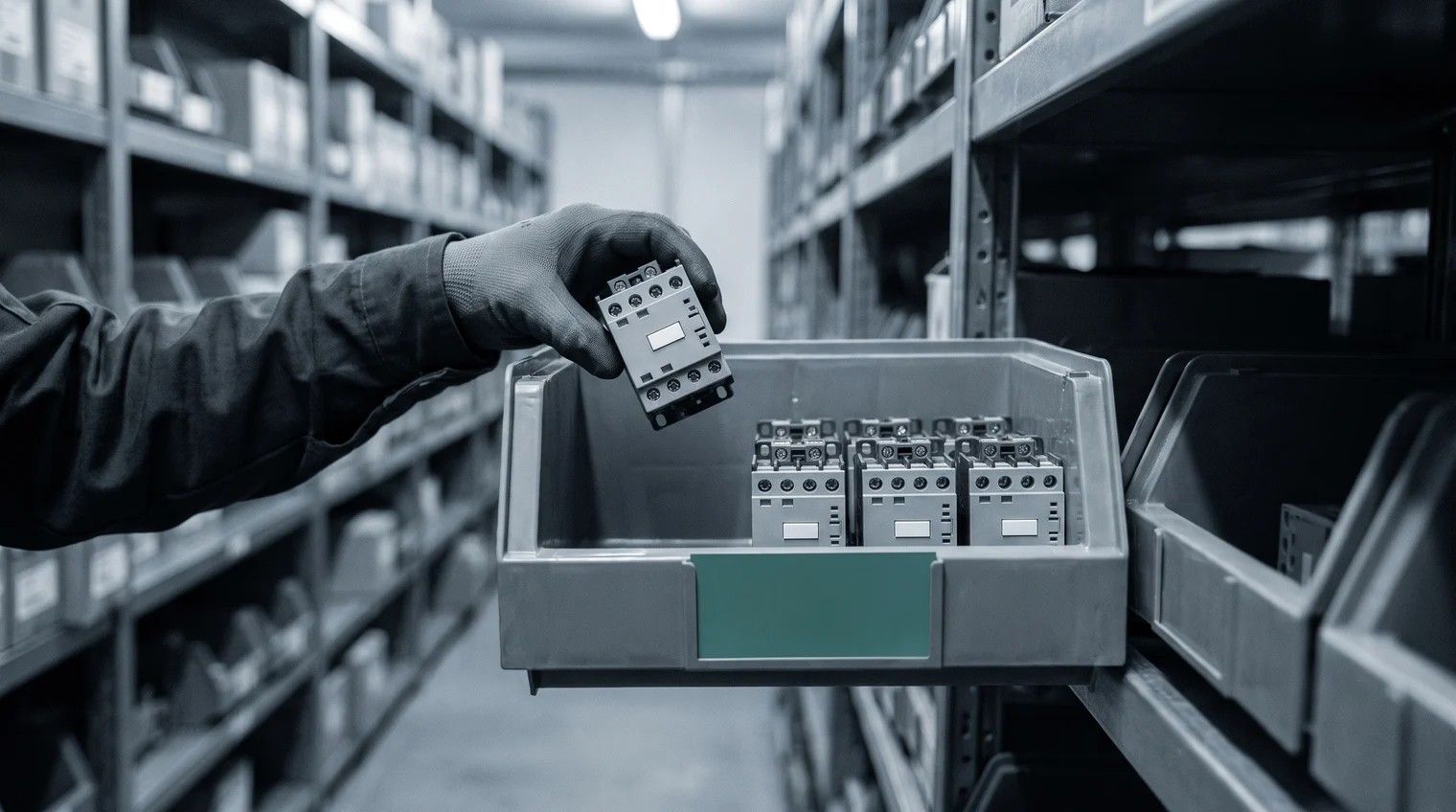
Every storeroom manager knows the call. A technician or a buyer says the part is not in the system. The storeroom manager types something slightly different, scrolls, and finds it in two minutes, under a description nobody would think to search for. Both of them were right: the part was in the master, and the search could not find it.
That gap matters more than it looks. A part that cannot be found is a part that gets ordered again, often from the wrong supplier, and often created again as a new record. So the quality of the search decides a good deal of what the material master turns into.
Spare parts search in the material master fails on how parts are written
Take one common part, an 18 A contactor with a 24 V DC coil, and look at how it tends to appear across a few plants and a few years of records. One plant has "CONTACTOR 3P 18A 24VDC". Another has "SCHUETZ 3POL 18A 24V DC". A third has "CNTCTR 18A COIL 24VDC 3P+1NO", and an older record at the first plant reads "CONTACTER 3P 18 A 24 V".
Each record was typed by someone who knew exactly what they were holding. Each one breaks an exact search in its own way. The German record says Schütz, written without the umlaut because the field did not take it. The abbreviated record drops vowels to fit the short text field. The last one has a typo and spaces between the numbers and their units. A search for "contactor 18A" finds the first record and misses the other three.

Add the other usual suspects: word order ("24VDC CONTACTOR"), a dealer's part number in place of the maker's, a description copied from an old purchase order, a record that names the machine instead of the part. None of them is a mistake anyone would catch in a data review, because each record looks fine on its own. The trouble only shows when someone searches across all of them.
Better keyword search still misses parts
It is tempting to treat this as a tuning problem for the ERP search. Fuzzier matching and wildcards do help. They do not close the gap. A 2026 study from SUPSI in Lugano tested retrieval on real spare-part descriptions from several sites (Bulloni et al., SUPSI, 2026, on arXiv). A keyword search over descriptions and specifications put the correct part first in about three of four cases. The best methods the authors tested raised that, and still missed roughly one part in five. Their conclusion is the storeroom's experience: the right part often exists somewhere and still cannot be found.
The misses also do not fall evenly. They land on exactly the records the contactor example shows: parts stocked at several plants, described in several languages, created by different people over the years. Those are often the parts where finding the existing stock matters most.
What a search on a real material master has to do
Cleaning every record first sounds like the answer, and for a large master it rarely finishes. The search has to work on the master as it is. In practice that means four things. It finds the part from the words the requester has, not from the words in the record. It forgives typos, abbreviations and the other language's word for the same thing. It shows the same part filed under different article numbers as one part. And it stops a missed search from turning into one more record.
The fourth point is the one that keeps the problem from growing. Every part that gets created twice because a search missed it is one more record the next search can miss. Off-contract orders often start the same way, as maverick buying in MRO shows.
Before changing anything, measure your own search. It takes about half an hour:
- Pick five parts you know are in stock, at least two of them at more than one plant.
- For each, write the request the way a technician or a buyer would, from the label or from memory.
- Search the material master with exactly those words.
- Count how many of the five come back, and how many of their duplicate records come back with them.
- Repeat with a colleague's wording for the same five parts.
If all five come back both times, your master and your search are in better shape than most. If two or more go missing, you know where purchases and new records are coming from.
A search that works on the master as it is
For the storeroom manager on the phone with the technician, the fix has to sit in the search. Partium Cockpit starts there. Semantic Multi-Modal Search finds the part from the words you have, even when the record behind it is messy. The technician's "contactor 18A" reaches the German and the abbreviated records too, because the search reads what the part is, not only how it was typed. It forgives typos and the many ways one part gets written.
The records the search brings together also show what the master needs. Duplicate Monitor finds the same part filed under different article numbers. When a request turns out to be a part you already have, the record stays single. It stops a new record from adding one more.
None of this needs the master to be clean first. Run the five-part test, then run it again with the search in place, and compare the misses. Book a demo, or ask for the demo license and run the test on your own catalog. For what a missed search costs once it reaches purchasing, read why MRO buyers reorder parts they already have.
See it on your own catalog.
Book a demo, or start with a demo license.