October 15, 2026
•
Maintenance & MRO
•
Philipp Begala
Dead Stock in Spare Parts: Sort It Before You Clear It
Dead stock in a spare parts storeroom is not one pile. Sort each part by why it stopped moving, and the list becomes one that maintenance can sign.

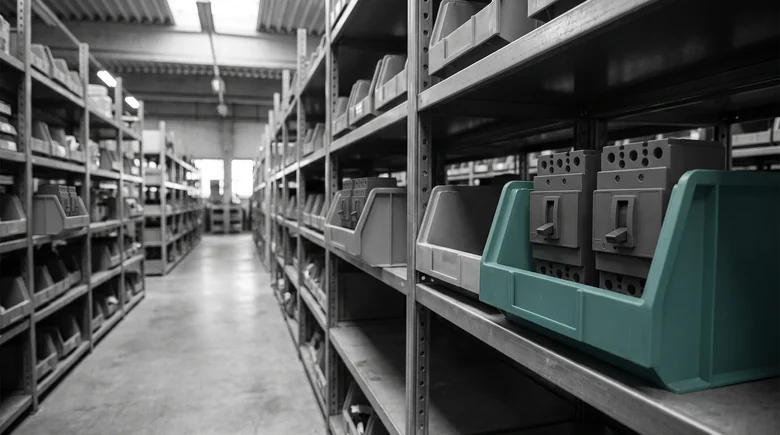
Finance wants the stock down, and the storeroom manager has the list to prove it can be done: every part with no withdrawal in three years. On the bench by the door sit twelve cast-iron V-belt pulleys under a film of dust. One was fitted. The other eleven have waited ever since. Further down the same list is the spare clutch-brake unit for the main press, which has not moved in eight years either, and which the plant cannot run without. Both parts look the same in the report. Only one of them can go, and the head of maintenance knows which.
Dead stock builds up for good reasons
Stock is how the storeroom keeps its promise of availability, so keeping too much always feels like the safe side. Maintenance has learned what a stock-out costs, and a part on the shelf is the answer it trusts. Procurement calls the result hoarding. From the shop floor it is a rational response to the last time a line waited for a part.
Three more habits add to the pile. A part needed once is bought in a dozen, because the price break or the supplier's minimum order made twelve look cheaper than one. That is how the pulleys arrived. A machine is taken out of service, and its spares stay on the shelf, still booked, still counted. German maintenance teams have their own words for what this leaves behind: Lagerhüter, parts that guard the shelf, and Ersatzteilleichen, spare-part corpses.
Research shows how quickly a part slides from slow to still. In a 2011 study of service parts, researchers at Erasmus University Rotterdam found that more than half of the parts ordered only once saw no further demand in the period that followed, far more than chance would predict. A case study of an elevator maker's spare-parts organization at the University of Vaasa named errors in the planning data first among the causes of excess stock. Wrong reorder settings and records that do not describe the part keep buying what nobody draws. So before you cut, look at how each part got there.
Sort dead stock spare parts by why they stopped moving
One word needs a line of its own. "Obsolete" in the storeroom has two meanings. The first is a part discontinued by its maker, which is a lifecycle question. The second is stock that no longer moves, which is the subject here. A part can be one without the other.
Take one storeroom at a stamping plant and four parts from finance's list. The first is a set of gripper fingers for a transfer unit that came out when press line 2 was rebuilt. No machine in the plant takes them. The second is the eleven pulleys, bought in a quantity nobody needed. The third is a hydraulic gear pump that has not moved here in four years, while the buyer at the sister plant is about to order the same pump. The fourth is the clutch-brake unit, which has never been drawn and must stay on the shelf.
Only the first two are dead stock. The gripper fingers serve a machine that no longer exists, and the pulleys will outlast the press they were bought for. The gear pump is a transfer waiting to happen. The clutch-brake unit is insurance the plant has already paid for, and it stays. A report that sorts by the date of the last withdrawal puts all four in one column. Sorting by why the part stopped moving gives each one its own decision.

The same review finds the parts that ran out
The list of parts nobody draws has a twin. In the same storeroom, the parts that are drawn every month run out, and a line waits for a part while the shelves hold others that nobody touches. Both come from the same habits: stock set once and seldom checked, bought by the price break rather than by use. This is the second of the maintenance cost drivers, stock in the wrong place, paid for twice.
That gives the review a second purpose. The capital that clearing frees does not need to go back to finance untouched. It goes first to the parts that ran out in the last year, because those are the stock-outs that taught the storeroom to hoard. When the shelves hold what is drawn, the case for holding twelve of everything gets weaker. Ask the storeroom for its list of last year's stock-outs, and put it beside the dead stock list before the meeting.
Transfer first, keep the critical spares, then clear
The order of the review matters more than its speed. Start with each part, the capital tied up in it, and its criticality. Then ask whether another plant needs it, because a part moved to a sister plant is a part nobody has to search for and buy again. The gear pump leaves this step on a truck to the sister plant.
Next, take out the critical spares. Maintenance sets which parts the plant cannot run without, and that judgment outranks any turnover figure. The clutch-brake unit leaves the list here and does not come back to it. What is left is the dead stock proper: spares for machines that are gone, and quantities nobody needed. Those can be sold, returned or scrapped.
Before anything leaves, the list goes to maintenance for its signature. Ask your most experienced plant engineers to read it as well. The list holds parts for older machines that are now hard to get, and they are the people who know which press still takes the old part. A signed list is also one that procurement can defend when finance asks why some slow stock stayed. For the wider practice of keeping a storeroom in shape, the spare parts management guide covers what comes before and after this review.
Partium Cockpit sorts the list and keeps the critical spares on the shelf
Partium Cockpit runs this review across your whole catalog, and maintenance keeps the last word. It shows the capital tied up in stock nobody draws, part by part. That answers finance's question, and the storeroom needs more than that to sort the list. Cockpit lays out dead stock and overstock, part by part, with the capital tied up in each and its criticality. Before anything is cleared, the gear pump goes where it is needed. Cockpit finds the plant that needs stock another plant holds. The clutch-brake unit never reaches the list to cut. The criticality your team sets outranks the model, so a spare the plant cannot run without is not flagged as stock to cut.
Start this week with one storeroom. Pull every part with no withdrawal in three years, take the twenty that tie up the most capital, and sort them into the four kinds: transfer, keep, removed machine, bought too many. Then take the list to maintenance before it goes to finance. To run the same sort on your whole catalog, book a demo and ask for the demo license on your own catalog.
See it on your own catalog.
Book a demo, or start with a demo license.