November 10, 2026
•
Aftermarket & Service
•
Philipp Descovich
Aftermarket Service Parts Sales: Three Reasons Customers Buy Elsewhere, and the One You Can Fix
Service parts sales leak to distributors for three reasons: price, lead time and ease of ordering. Tell them apart, find out which one costs you most, and fix the one that sits inside your own portal.
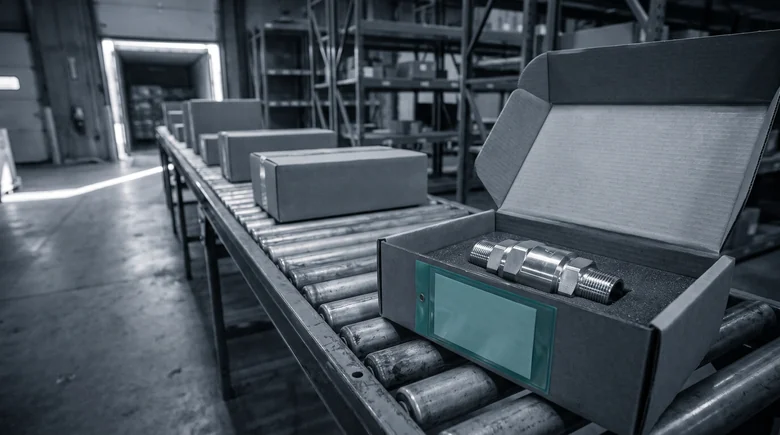
A plant engineer needs a replacement check valve for the coolant return on one of your machines. They search your parts portal for "valve, coolant return, 3/4 inch", get nothing back, and call the hotline, which is busy. A distributor answers the same request within the hour, and the order goes there. You had the valve in stock the whole time.
Service parts sales carry the business
Your parts business is worth defending. In a 2021 study of industrial companies, Bain found that services average 35% of revenue and 60% of profits. In 2025, BCG put gross margins on spare parts and consumables at about half of sales. And service holds when the rest falls: in a 2026 study by the German service association KVD and Roland Berger, a 30% drop in product revenue typically took service revenue down by five to eight percent.
So every valve bought from a distributor is margin that left your books, and most heads of aftermarket know that part of their installed base buys elsewhere. What is harder to see is why. Customers leave for three reasons: price, lead time and ease of ordering. Each needs a different fix, and you control each to a different degree, so the first job is to tell them apart.

Price decides the standard parts
Some parts are standard. A seal, a fitting or a sensor with its maker's number on it is sold by distributors too, often for less, and a customer who searches by that number finds the cheaper offer. Part of your installed base will always buy those parts on price. That share of the leakage comes with selling standard parts, and your pricing decides how large it is. How to set those prices is a subject of its own. For now, mark the parts in your catalogue that carry a maker's number a distributor can quote. Those are the orders price decides.
Lead time is a logistics question
The second reason is distance. You ship from one central warehouse, and the distributor has the part on a shelf down the road. For a plant with a machine standing still, tomorrow morning beats the day after, whatever the price. Closing that gap means regional stock, consignment stock at large customers or faster shipping, and each has its cost. It is a decision for the people who run your warehouse network. Note which of your lost orders were urgent: those are the ones lead time decided.
Ease of ordering is the reason you control
The third reason is the one in the example. The plant engineer compared neither prices nor delivery dates. They found nothing in the portal and bought from a distributor, because the distributor answered first. Of the three reasons, this is the one you control most directly: the portal, the search inside it and the time to a quote are all yours.
An empty search is rarely an empty catalogue. The valve was there, under its article number and the description engineering wrote for it, "check valve DN20 PN16". The customer typed what they saw at the machine. Why that gap returns nothing, and how to close it, is the subject of why your parts portal search returns zero results. The same gap sits behind the hotline. When the portal fails, the request lands on the parts desk, and a two-day wait for a quote does the rest.
Customers bring to a portal what they have at the machine: a few words, the characters left on a worn label, the machine's serial number, sometimes a photo. A portal that answers only to the exact article number turns most of that away, and the customer rarely tries a second time. You can test this on your own portal in an afternoon. Take ten recent hotline calls, type in what each caller said first, and note how many searches find the part. Every miss is an order that was easy to lose, and the hotline log shows you which words to start with.
To see which of the three reasons costs you most, start from the installed base. Take one product line and estimate, for each machine in the field, the parts orders you would expect from its age and its hours. Compare that with the orders you received. The difference is what goes elsewhere. Then call five customers who order little, and ask each of them about five things:
- Where they buy: which parts for your machines they last bought elsewhere.
- What decided it: the price, the delivery time or finding the part.
- What they tried first: your portal, your hotline or nobody.
- What happened there: what they searched for and what came back.
- What would have kept the order: the one thing that would have made them order from you.
Five conversations are a small sample, but they tell you which reason to work on first. Where the answer is ease of ordering, the fix belongs inside the portal your customers already use. Find searches your own catalog and works beside your ERP and CMMS. For OEMs, it runs as a search inside the parts portal or shop you already have. Partium Find identifies the spare part from whatever you have at the machine: a photo, a label, a code, a few words or the bill of materials. It does nothing for price or lead time. At ENGEL, Partium's AI-based spare part search in the ENGEL parts portal lets technicians find parts independently — with fewer part-search hotline calls, more self-served transactions in the shop, and more requests for quotes. Read how ENGEL runs it.
Start with one product line: compare expected against actual parts orders, and talk to five customers who order little. If ease of ordering is the reason they give, book a demo and see how Find handles the searches your customers tried, on our demo catalog or on a sample of yours.
See it on a catalog like yours.
We show you Partium live, on our demo catalog or on a sample of yours.