
October 15, 2026
•
Maintenance & MRO
•
Philipp Descovich
Identifying Critical Spare Parts by What Happens When One Is Missing
A critical spare is decided by what happens when it is missing, not by how often it moves. Identifying critical spare parts comes down to four facts about each one, and maintenance signs the list.
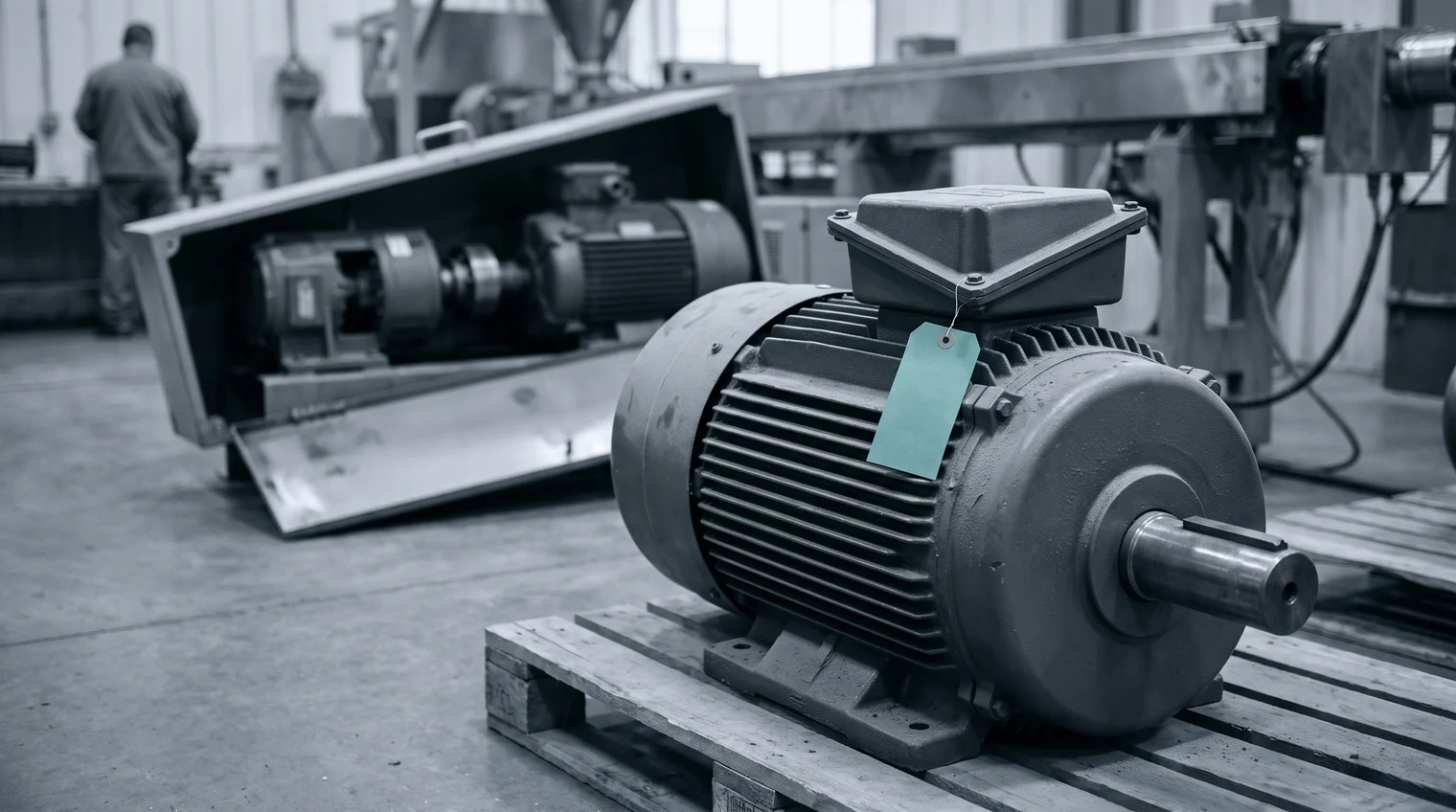
A plastics plant runs one pipe extrusion line, and the line runs on one main drive motor. On a pallet at the end of the line stands a spare motor of the same type. Nobody has drawn it in years. In this year's stock review it sits near the top of the report of parts that have not moved, and its value makes it look like the easiest saving in the building. If the running motor fails and the spare has gone, the line stands until another one arrives.
Stock reductions reach the storeroom with a target and a report sorted by movement. The head of maintenance holds the technical veto over that storeroom, and the storeroom manager keeps the list of what stays. Both have to say which spare parts the plant cannot give up, in terms that procurement and finance accept. Four facts about each part give them those terms, and the list they produce is maintenance's to sign.
Turnover is the wrong test for a critical spare
A stock review sorts by movement because movement is what the ERP records best. Parts that have not been issued in three years look like dead weight, and for most of them that judgement holds. The parts that matter most are the exception. A spare kept against a rare, expensive failure is bought in the hope that it never moves. Sorted by movement, it lands first on the list to cut.
Heads of maintenance describe the problem in their own words: for a critical spare, criticality decides whether it is cleared, and its turnover is beside the point. The trade press sees the same gap from the other side. Plant Engineering's 2022 report on industrial maintenance, written with ATS from a survey of maintenance managers, says it in one sentence: "Ready availability of critical parts is rarely assured."
A missing critical spare is the first of the maintenance cost drivers a plant can control, because it decides how long a stop lasts. Setting stock by criticality is where the work on critical spares starts. Before a report sorted by movement reaches the next meeting, take off it the parts maintenance would fight for, and give each one a reason that does not depend on turnover.
Identifying critical spare parts takes four facts
Research has worked on criticality classification for decades. A 2025 systematic review in the Gazi University Journal of Science, on spare parts classification from the maintenance side, finds the criteria widening beyond cost and lead time toward strategic ones such as supplier predictability. An earlier review by researchers at the Politecnico di Milano describes the barriers that keep plants from applying multi-criteria classification at all. A list a plant can keep needs fewer criteria, each of them a fact somebody can look up and somebody else can check. For each candidate part, record four:
- Consequence of failure. What happens to the machine the part serves, and to the line behind it, when the part fails and none is on the shelf.
- Lead time. How long another one takes today, from the maker or from any other supplier.
- Still made. Whether the maker lists the part as active, phasing out or obsolete.
- Held elsewhere. Whether a sister plant already holds one that could be moved.
For the extruder's drive motor, the four facts read like this. If it fails, the line stops, and the plant has one line. The maker quotes a lead time in months. The maker also lists the motor as phasing out, so in time that lead time turns into a last order date. A sister plant holds one of the same type, guarding its own line. Three of the four facts say keep the spare. The fourth shortens the risk without removing it, because the sister plant's motor is a backup to the spare, and moving it leaves that plant exposed.

Each fact carries its own source, which is what lets the line stand up in a meeting with finance. A part whose failure stops a line, whose lead time runs to months and whose maker is phasing it out stays on the list whatever its movement report says. Write the four facts beside each part on your list, and note where each one came from.
Maintenance sets the criticality and signs the list
The four facts come from different places. The consequence of failure comes from maintenance, who know the machine and the line behind it. Lead time and status come from makers and suppliers, often through procurement. Stock at other plants comes from the storeroom records. The decision on criticality belongs to maintenance, because maintenance answers for the stopped line. Procurement and finance can question a line on the list, and maintenance answers with the four facts.
The list also goes out of date. Re-check a part when something it depends on changes: a machine is added, moved or retired, a supplier changes its lead time, a maker announces the part is phasing out, or a sister plant uses its spare. Between those events, a scheduled read-through with the storeroom manager catches what slipped. The parts that fail all four tests are the ones a stock reduction can look at first, and a separate post on dead stock covers that side. Put the date of the last check on each line, so the next review knows which facts are fresh.
Partium Cockpit keeps three of the four facts in reach
In Partium Cockpit, the first fact stays with maintenance, and the other three can be looked up instead of chased. Nobody calls each maker in turn. Select the parts, and Partium Agent finds their suppliers and lead times, what each should cost, and whether it is still made. The status uses the same three words as the list. See if a part is active, phasing out or obsolete, so you plan for obsolescence instead of reacting to it. The sister plant's stock comes from a search. One search shows where the part is stocked, at every plant, so you find it before you buy it again. The signed list counts in the stock review too. The criticality your team sets outranks the model, so a spare the plant cannot run without is not flagged as stock to cut.
Start this week with ten parts: the ten you would fight for in the next stock review. Write the four facts beside each one, with the source of each fact, and have the head of maintenance sign the sheet. Where a fact is missing, you have found the line most likely to be cut. To check the same four facts across your whole catalog, book a demo, or ask for the demo license on your own catalog.
See it on your own catalog.
Book a demo, or start with a demo license.