October 15, 2026
•
Maintenance & MRO
•
Philipp Descovich
Identify a Spare Part Without a Part Number by Putting the Clues Together
The part is usually in the catalog. To identify a spare part without a part number, combine every clue the part and the machine still carry, and hand the clues on so the record is easier to find next time.
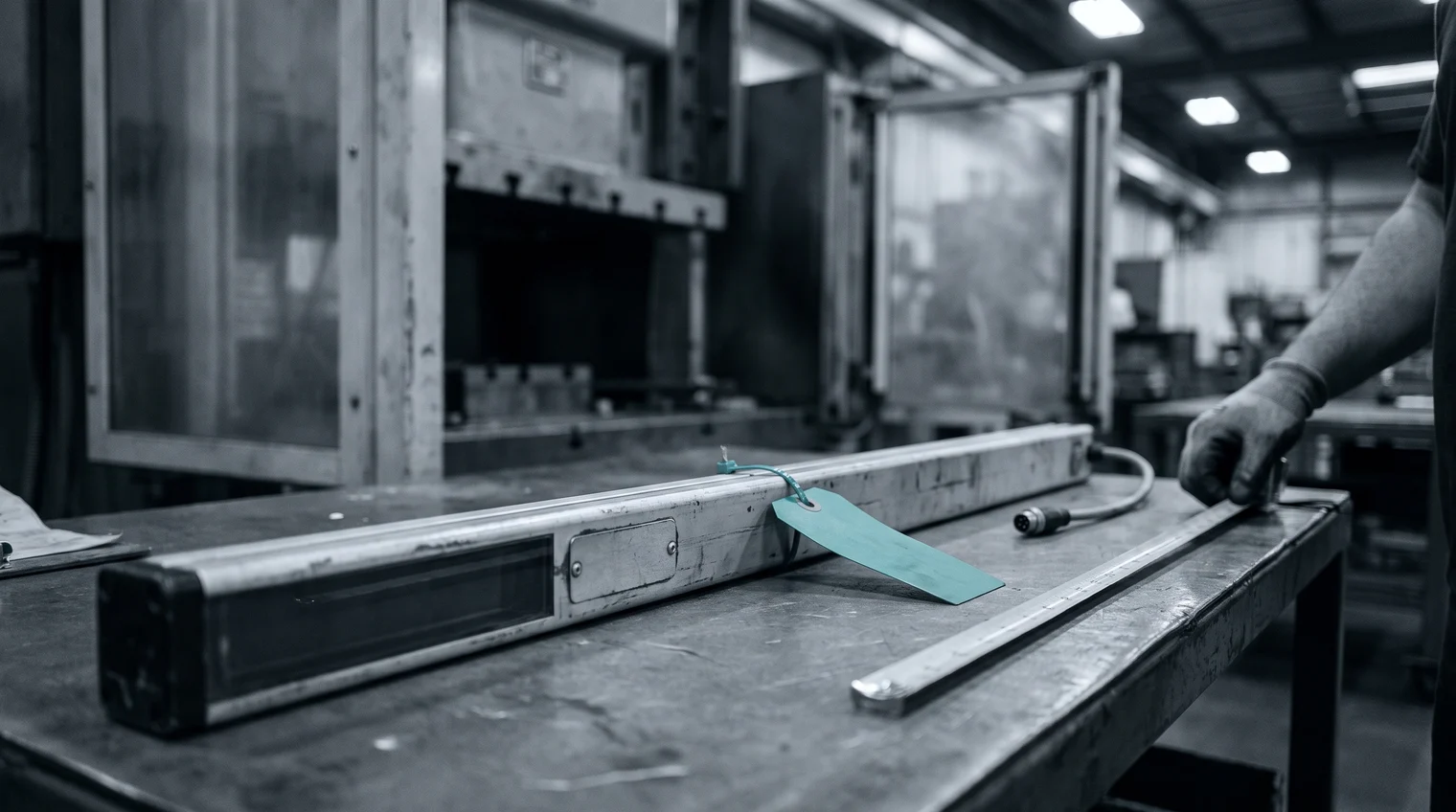
On Monday morning, press 4 in a stamping plant will not cycle. The safety light curtain across its infeed reports a fault, and the receiver bar is the part that has failed. The technician has it on the bench within minutes. The label on its housing is scuffed: the maker's logo has gone, and the type code has lost its last characters. The press builder's parts list names the bar under the builder's own number. The plant's material master holds a record for it, created when the press arrived, with a short text that abbreviates the name in German. The technician types "light curtain receiver" and gets nothing back.
Every clue on that bench is real, and none of them is a part number. The part is in the catalog. The search fails where the technician's clues meet the record's words, and that meeting point is where maintenance can win the time back. You can identify a spare part without a part number when every clue counts and each one narrows what the others leave open.
The clue and the record were written by different people
Ask why spare part search is hard at the machine, and the answer is rarely a missing part. It is several descriptions of one part, written by people who never met. The component's maker printed a type code on the housing. The machine builder bought the part from that maker, gave it a number of its own and listed it in the parts list. Someone at the plant created the material record, often years later, with the words and abbreviations that made sense that day. The technician arrives with one more description: what the part does and where it sits.
Time widens each gap. Labels wear, and get painted over during a refit. Makers rename a product line, and the number in the manual leads to a model that no longer exists. The record keeps the words it was created with, and nobody searches in those words again. A search that matches exact words finds nothing for "light curtain receiver" when the record says "LICHTGITTER EMPF.", and the technician concludes the part is not in stock. How a search can cope with the record side of that problem is the subject of spare parts search in the material master.

The gap repeats, so it can be studied. The next time a search at the machine ends empty and the part turns up later, write down the clue you started with and the words the record holds. After ten such pairs, you know which gap costs your plant the most time.
Identify a spare part without a part number by combining clues
Each clue on its own narrows the search a little. A fragment of a type code matches a whole product family. "Light curtain" matches every light curtain in the catalog. The parts list narrows the search to one assembly of one machine, and a measurement narrows it to one size. Together they leave few candidates, often one. Each clue rules out what the others let through.
Before the part goes into a bin, collect every clue it and the machine still carry:
- The label or nameplate. Every legible character, even a fragment of the type code.
- Any code. A barcode or QR code on the part, its packaging or the machine.
- Its job and place, in your words. What the part does and where it sits.
- What you can measure. A length, a diameter, a thread, the voltage on the connector.
- The machine and its parts list. The machine's type plate and the assembly the part belongs to.
- A photo of the part as it is. Worn, dirty or half painted over.
For the receiver bar, the clues narrow quickly. The fragment of the type code names the product family. The measured protective height, 1,350 millimetres, and the beam spacing leave two variants in that family. The press builder's parts list puts one of the two on the infeed of press 4. The record that matches carries the maker's part number, and the bar in the technician's hand agrees with it. On a safety device, that last check is the one that counts: the replacement is the same type, confirmed against the part, and a close match is not good enough.
Keep the six clues together for each request, on one card or one screen, so whoever searches next starts from all of them and not from the one that happened to be passed on.
Hand the clues on with the part
Once the part is found, the clues have done half their work. The other half is the record. In the example, the record that matched has a German short text and an empty field for the protective height. The next technician who searches in English for a 1,350-millimetre receiver meets the same gap. The clues collected at the bench are what the record lacks: words a technician uses, the dimension, the position in the press.
The person who adds them is usually the storeroom manager or whoever keeps the material master, not the technician. So the clues travel with the request: the label text, the measurement, the parts-list position and the photo, attached to the reservation or the work order. Completing the record stays with the people who own it, and ten minutes at the bench become the next search's head start. For the habits that make the search itself work, from the nameplate to the stock at other plants, see nine ways to find the right spare part faster.
Agree this week with your storeroom who receives the clues, and in which field of the work order they go.
Partium Find takes every clue as it comes
Partium Find lets the technician start from whichever clue the part still offers, and add the next. The label is often the first thing in reach. Scan the label or nameplate, and Find returns results from the text on it. A code on the part or the machine saves the reading. Scan a barcode or QR code to go straight to the part. The technician's own words count as much as the record's. Type what you know: a few words, a function, part of a description. Find searches by meaning, not by exact naming. A worn part is still a clue. Take a photo of the part. Find matches it even when the part is worn, dirty or obfuscated.
The machine narrows what the part can be, and the measurement settles between variants. Use the bill of materials to narrow down a part that is hard to name. Narrow the results by manufacturer, dimensions or category. The clues then finish their work at the record. When a part's record is incomplete, you complete it in Partium Cockpit: Partium Agent proposes what is missing, and your team decides. At Deutsche Bahn, the clues come from a rail fleet. DB Cargo's fleet spans decades of locomotives and freight cars, and their documentation is often incomplete or missing. Partium searches across the data DB Cargo has: material lists, descriptions, SAP numbers, drawing numbers, manufacturers, stock and storage locations.
Start this week with the last three parts that took longest to identify. For each one, write down the clues the technician had and the words the record held when the part was found. Where the two share no word, you have found a record to complete and a search that needs more than words. To try every clue on your own catalog, book a demo, or ask for the demo license on your own catalog.
See it on your own catalog.
Book a demo, or start with a demo license.