November 3, 2026
•
Aftermarket Parts
•
Philipp Begala
Spare Parts for Older Industrial Machines: Identifying the Part When the Documentation Is Gone
Requests for spare parts for older industrial machines arrive with the least to go on: a machine number, a worn label and a photo. Ask for five things, narrow them in the order the machine was built, and the desk can name the part without the drawings.
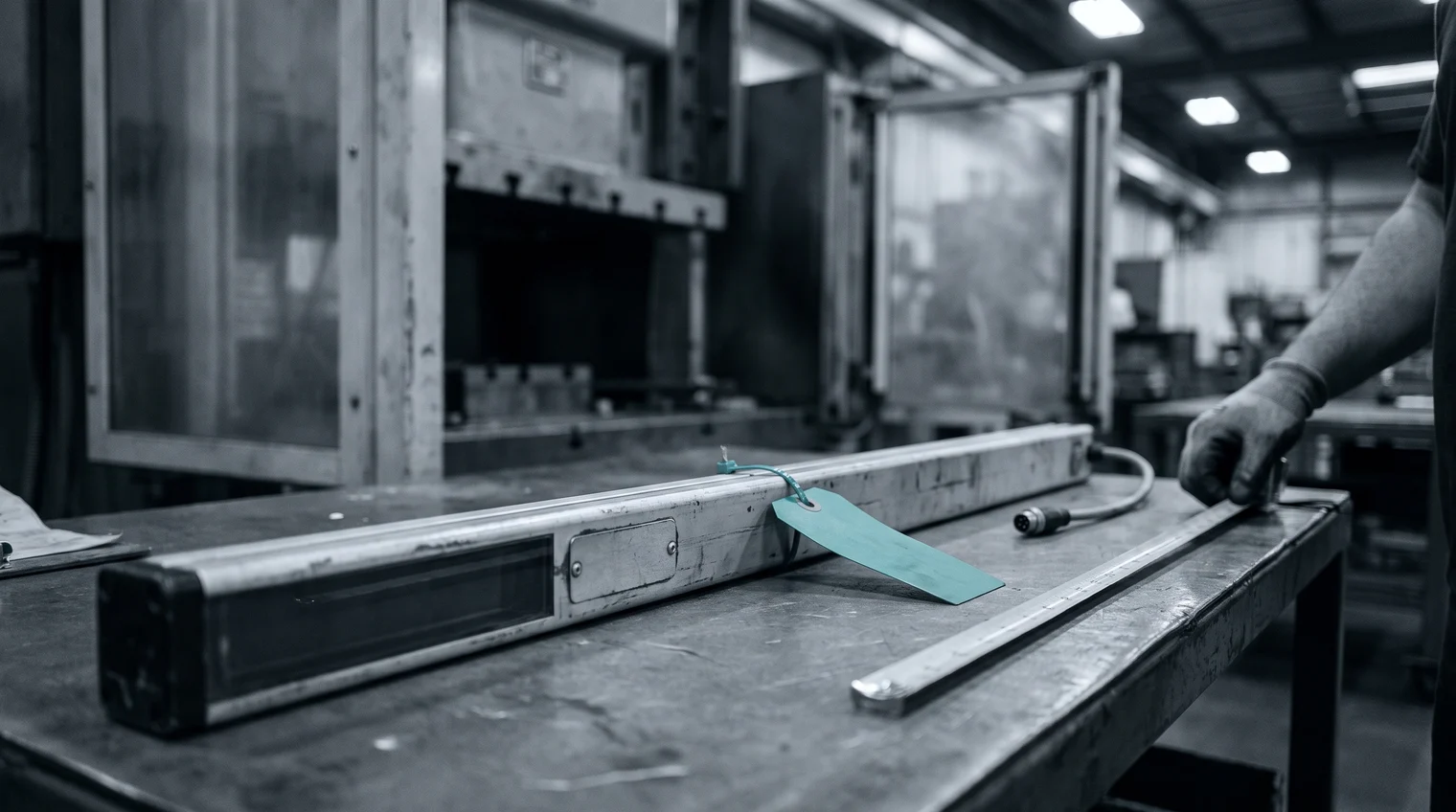
A customer writes to the parts desk on a Monday morning. Their hydraulic press has stopped, because the limit switch that reads the ram's end position no longer switches. The press left your factory twenty years ago. The email holds three things: the switch's label, worn down to two legible characters, a 7 and an R; the machine number from the frame; and a photo the fitter took with the switch still mounted. Nobody on the desk today has seen this press.
This is the everyday request on an old installed base, and it is the hardest one the desk gets. The part number is gone, the nameplate painted over twice, and the customer has a press standing still until somebody names the right switch.
Older machines outgrow their parts list
Capital goods stay in service for a long time: five to thirty years, as a 2015 University of Twente paper on spare parts puts it. Over those years, three things drift apart. The machine changes on site, because a switch is swapped during a repair or a bracket is moved to fit a new tool. The parts list in your system stays the one the machine left the factory with, or a later revision that nobody kept. And the people who built and serviced the machine retire, taking with them what they knew about the exceptions.
So the oldest machines bring the requests with the least to go on. The drawings are on paper in an archive, if they exist at all. The customer's maintenance team often has less documentation than you do, and a fitter at the machine sends what they can see. On the plant's side, this is the problem of a spare part without a part number. On your side, it is a request the desk has to answer before the customer buys elsewhere.
An intake list for spare parts for older industrial machines
Most of the time on an old-machine request goes into asking. Each round of questions back to the customer costs a day, and the clarification round between inquiry and quote is longest when the documentation is thin. Ask for everything that can settle the part in the first reply, in this order:
- The machine number, from the frame or the original nameplate. It leads to the parts list the machine shipped with.
- Whatever is left of the part's label, every legible character, even two.
- The installation position: which assembly, which side, what the part does there.
- Two or three measurements, the ones that tell the variants apart: a length, a thread, a mounting distance.
- A photo of the part in place, before it is removed, with something in the frame for scale.
Desks that serve older plants fall back on the same few inputs when the documentation is incomplete: the machine number, the position and a photo. Writing them down as a list lets anyone on the desk ask for them, including the colleague who joined last month.
Narrow it down in the order the machine was built
With the five inputs in hand, the desk narrows the candidates in a fixed order: machine number, position, label remnant, measurement. Each step removes most of what the one before it left.
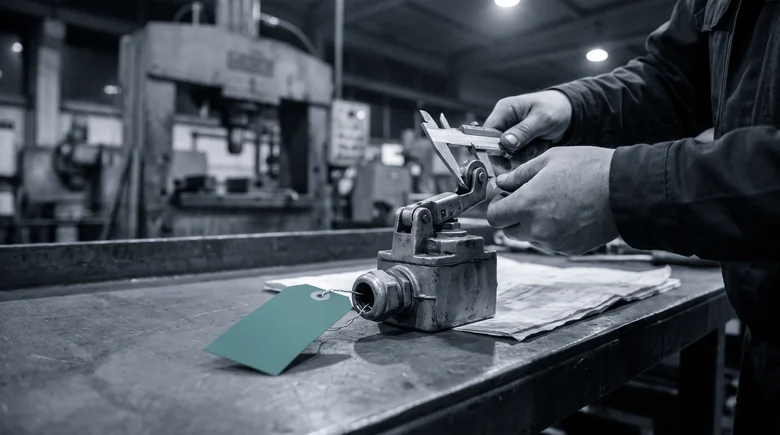
The machine number gives the original parts list. For the press, that list names one limit switch for the ram's end position. The parts-list revisions since then name two more that have sat in the same position, so the position gives three candidates: a switch with a roller lever, one with a plunger, and one with a longer roller lever, fitted after a tooling change. The photo rules out the plunger, because the fitter's picture shows a lever. The remaining characters, the 7 and the R, match both lever switches, because the R marks the roller lever type in your numbering. One measurement settles it: the customer measures the lever from its pivot to the centre of the roller, and only one of the two has that length.

The order matters because each input means more once the one before it is known. Two characters say almost nothing across a whole catalogue. Within three switches that fit one position on one press, they rule one out. When none of the candidates fits the measurement, the machine was changed on site, and that is the point to hand the request to engineering.
Let the search start from what is left
Partium Find runs the same order inside your own catalogue. Scan the label or nameplate, and Find returns results from the text on it. Use the bill of materials to narrow down a part that is hard to name. Take a photo of the part. Find matches it even when the part is worn, dirty or unlabelled.
Resilient when data is not. A wrong field, a gap or a worn label does not stop the work. The AI works around what is missing, and your ERP stays the system of record. Find searches your own catalogue, so a switch that was never catalogued stays a question for engineering.
Start with your own requests. Take the last ten requests for machines older than fifteen years and note which input settled each one: the machine number, the position, the label, a measurement or the photo. Then book a demo and see how Find handles requests like those ten, on our demo catalog or on a sample of yours.
See it on a catalog like yours.
We show you Partium live, on our demo catalog or on a sample of yours.