October 10, 2026
•
Aftermarket & Service
•
Philipp Descovich
From Spare Parts Inquiry to Quote, Without the Second Round
A spare parts inquiry rarely arrives with a part number. Before the parts desk can quote, someone works out which part it is, and that round often goes back to the customer and to engineering. Here is how to make it shorter.
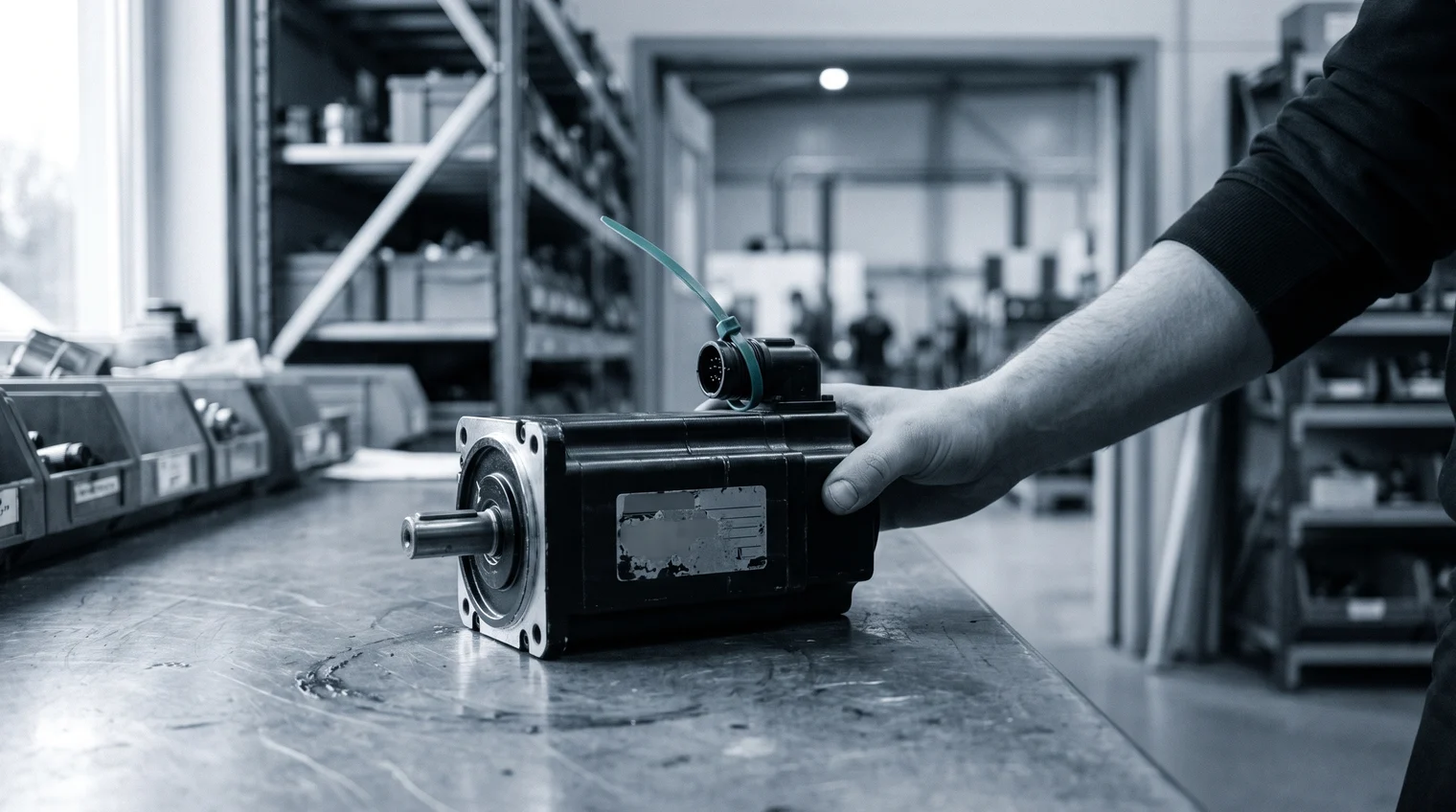
The email reaches the parts desk on a Tuesday morning. A customer's cartoning machine has stopped, and the maintenance lead needs a new servo motor. The message holds three things: the machine number, two words ("servo axis 3"), and a photo of the motor's nameplate, half painted over. There is no part number. The customer wants a quote today, and a same-day quote is what the desk aims for.
Whether the desk gets there depends less on the quote than on the step before it.
From part request to quote, and the round in between
Every parts desk runs the same relay. A part request comes in by email, phone or the portal. Someone clarifies which part it is. Then someone quotes. The first and last steps are routine. The middle one, the technical clarification, is the step that varies most. It depends on what the request contains and on who is in that day.
Follow the servo motor through it. The nameplate shows a manufacturer's logo and part of a type code. The desk asks the customer for the installation position. The reply comes back after lunch: the motor drives the carton feed. The desk opens the machine's parts list and finds the position. Under it sit three motor variants, because the machine was built in revisions and the motor changed twice. The parts list does not say which one this serial number got. The desk asks engineering, and the one engineer who knows that machine series is at a customer site until Thursday.

None of these steps is a mistake. Each one is the careful thing to do. OEMs describe their own parts service this way in public: when a part cannot be identified clearly, they ask for photos, the machine number and the installation position. The trouble is that every question is another round, and every round waits for someone.
Requests that start in the portal have their own version of this problem, covered in why parts portal searches come back empty.
What to ask for in every spare parts inquiry
Most second rounds happen because the first message was missing something the desk needed. You cannot make every customer send a perfect request. You can ask for the right things up front, in your request form, on the portal and in your first email reply. Five fields cover most of what the desk asks back for:
- The machine or serial number. It tells the desk which revision of the machine the part sits in, and that decides between variants.
- What is left of the nameplate. A partial type code, a manufacturer's name, a rating. Ask the customer to type what they can read, even when it is incomplete.
- The position in the parts list or manual. If the customer has the documentation, the item number or the drawing page settles more than any description.
- A few words on what the part does. "Drives the carton feed" says more than "servo axis 3", because it names the function.
- A photo, where it helps. One of the part in place and one of the nameplate, so the desk can check what the customer read.

The servo request with all five fields filled looks different. The machine number points to a revision. The nameplate fragment and the position narrow the parts list to one entry. The function confirms it. The desk can quote without asking back.
To see where your own second rounds come from, take last month's requests that went back to the customer. Sort them by what was missing: the serial number, the nameplate, the position, the function, a usable photo. One or two fields usually account for most of them. Those are the fields to make mandatory, or to ask for first.
Why a second round costs more than time
The relay runs on a few people. When a request is hard, the answer sits with the colleague who knows the machine, or with the engineer who designed the revision. That is not the habit of one desk. A 2025 study from the Technical University of Denmark found that decision-makers in spare parts management tend to rely on tacit knowledge, because gathering data across IT systems and departments takes too much effort (Didriksen et al., DTU, 2025, in Applied Sciences). Service managers who compare notes in a service association's exchange forum describe the same block on faster identification: knowledge held in individual heads and in free-text fields.
So the clarification waits for the person who holds the knowledge. The customer does not wait. A maintenance lead whose machine is down sends the request to two or three places and buys from whoever answers first with a part they trust. The head of aftermarket does not count that as search time. They count it as a sale the customer made somewhere else, and as a customer who may ask somewhere else first next time.
The wider point, that the answer is spread across systems and that a wrong part costs more than a late one, is made in the right part is the customer experience. This post is about the round between request and quote, because that is where the desk loses time it cannot make up.
Where the clarification gets shorter
The intake checklist reduces how often the desk has to ask back. It does not change how long identification takes once the request is complete. That depends on where the knowledge sits. Every decision about a part, whether to repair, reorder, consolidate or replace it, depends on knowing what the part is. That knowledge is scattered across catalogs, labels and the heads of a few experts. We built one platform so that the technician, the planner and the buyer all work from the same understanding of the part.
Partium Find brings that understanding to the desk, without a new system. Find searches your own catalog and works beside your ERP and CMMS. For OEMs, it runs as a search inside the parts portal or shop you already have. The servo request starts with the nameplate. Scan the label or nameplate, and Find returns results from the text on it. Three variants under one position still need a decision. Use the bill of materials to narrow down a part that is hard to name. The customer's own words go in next. Type what you know: a few words, a function, part of a description. Find searches by meaning, not by exact naming. Last comes the photo the customer sent. Take a photo of the part. Find matches it even when the part is worn, dirty or obfuscated.
The desk still confirms the part and writes the quote. Find shortens the identification inside that work, in your own catalog.
Start with last month's second rounds, sorted by what was missing, and put the five fields into your request form. Then see what a search in your own catalog does with the requests that remain. Book a demo, or ask for the demo license and run it on part requests your team has already handled.
See it on your own catalog.
Book a demo, or start with a demo license.