November 2, 2026
•
MRO Procurement
•
Philipp Begala
OEM Conversion: Buy the Part from the Company That Makes It
Many spare parts that carry a machine builder's number were made by someone else. OEM conversion records that maker and its part number in your material master, so the next order for the same part can go to the company that makes it.
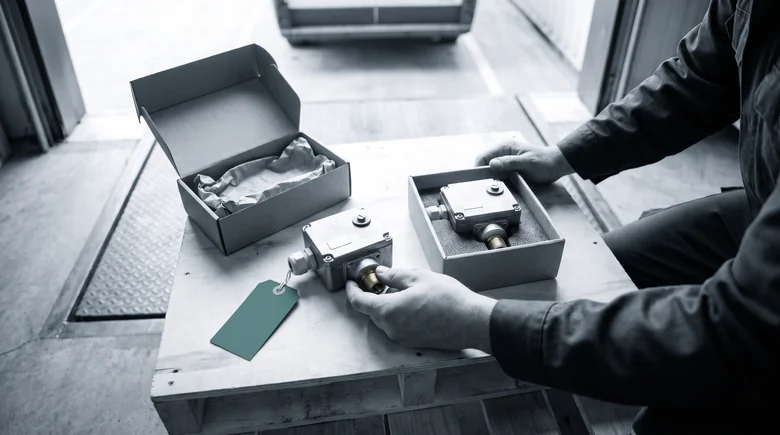
The reorder looks routine. A packaging line needs a new pressure sensor, the material master lists it under the machine builder's part number, and the last three orders went to the builder at the builder's price. The sensor in the storeroom tells a different story. Its housing carries the logo and the type code of a sensor maker that sells the same model through its own distributors, often with stock in the same state. The builder bought that sensor, put it on the machine and gave it a number of its own. The plant has paid the builder's markup on it ever since, because nobody wrote the maker's number down.
What OEM conversion is, and where it stops
OEM conversion means recording the maker and the manufacturer part number behind a machine builder's number, then buying the same part from that maker or from the maker's distribution. Nothing about the part changes. It is the same sensor, from the same factory, under the number its maker sells it by. That is why conversion is the safest move in MRO procurement: the plant is not trading one part for another, only one source for another.
The line is easy to cross by accident. If the maker's catalog lists a newer version, a different connector or another pressure range, the part has changed, and the decision becomes an approved alternate with its own checks, which the post on form, fit and function covers. Conversion is also narrower than the broader question of who else can supply a part when the OEM is the only source in sight; that search has its own post. This one is about a single move: same part, its maker, its maker's number.
Why the maker's number goes missing
The material master records what the plant was told when the machine arrived. That is the builder's spare parts list, so the record holds the builder's number, a short text and a price, and nothing about who made the part. The maker's type code sits on the part in the storeroom or on the machine, and sometimes in an old drawing. It almost never reaches the record, and every reorder starts from the record.
Over the years the gap compounds. The same sensor is bought for a second line under another builder's number, then once in an emergency from a distributor under the maker's number, and the plant ends up with three records for one part and no idea that they match. Each buyer who opens one of those records sees a single source and a fixed price. The first step of any conversion is therefore to find the maker behind the builder's number and put it where the next buyer will see it.
Which parts to convert first
Not every part should be converted, and the ones that should not are as important as the ones that should. A builder that modifies a part, calibrates it to the machine, tests it as an assembly or ties a warranty or a certification to its own number has added something to the part, and its number stays. So does a part where the builder's service is worth the price: a hard-to-reach component that the builder's technician fits under a service contract, for example.
For the rest, a short check decides whether a part is a candidate:
- the maker and the manufacturer part number are known and match the part on the machine
- the builder has not modified, calibrated or kitted the part
- no warranty, safety certification or service contract depends on the builder's number
- the part is bought often enough, or at a high enough price, for the conversion to matter
Start where those four hold and the spend is highest. In a US plant that list is usually led by electrical and hydraulic components and sensors, the parts builders buy in rather than make. Buying them from the maker can also shorten the route the part travels, which matters more while metal tariffs reach spare parts prices as surcharges.
Keep the conversion in the record
A conversion that lives in one buyer's inbox is lost with the next reorder. It belongs in the material master, against the original material: the maker, the manufacturer part number, the source the plant now buys from, and the date the conversion was decided and by whom. The builder's number stays in the record as a cross-reference, so maintenance still finds the part from the builder's manual, and the requisition still lands on the right material. When the three records for one sensor turn up, they are merged into one before the next order goes out.
This is the work Partium Cockpit is built for. Partium Cockpit is software for the teams who look after spare parts: maintenance and procurement. The dashboard shows what needs doing today, and the feature where you do it. For a conversion, the first question is who made the part. Supplier Discovery finds who else makes or sells the part, down to the OEM behind a dealer number. Where the record is too thin to answer, the gaps are filled first. Targeted Attribute Enrichment fills in the attributes a part record is missing: the ones your next decision needs. With the maker known, the price question follows. Price Benchmark tells you what a part should cost, so every price you pay has a reference. And the conversation with the builder changes too, because the buyer now knows what the part is and where else it can be bought. Prepare each supplier negotiation on one page: what you buy from them, and what it should cost.
Start with the parts your plant reorders most and see how many of them carry a maker's number nobody wrote down. Book a demo and see it on our demo catalog, or on a sample of your own parts.
See it on a catalog like yours.
We show you Partium live, on our demo catalog or on a sample of yours.