November 19, 2025
•
Obsolescence & Alternates
•
Philipp Descovich
Form, Fit, Function: The Discipline Behind Approved Alternates
Form, fit, function (FFF) is the discipline that turns a substitute spare part from a guess into a decision your team can defend and reuse. It comes down to what each of the three covers, what to record for an approved alternate, and who signs.
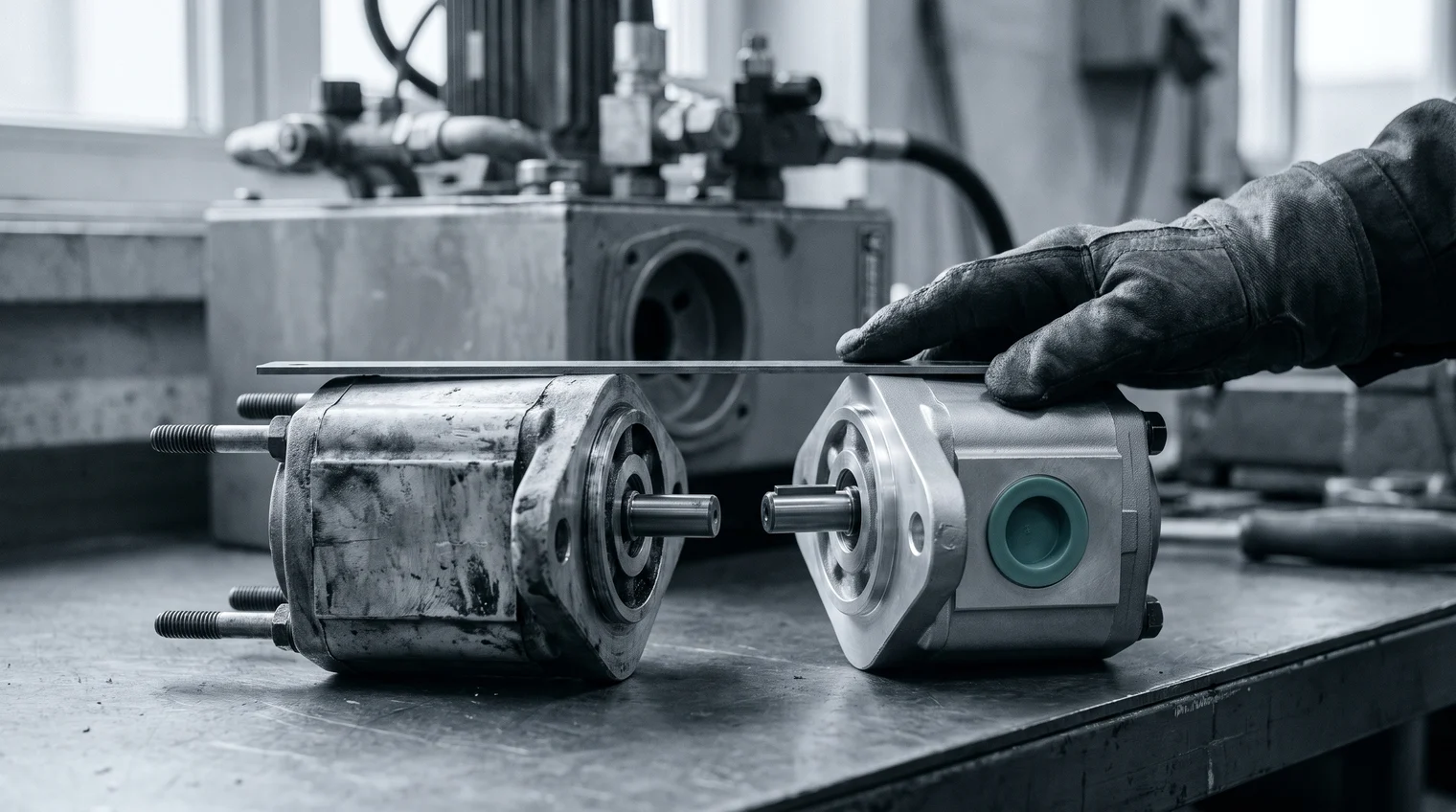
The gear pump on a hydraulic power unit is worn, and its maker has discontinued it or quotes a lead time the line cannot wait for. Someone finds a pump from another manufacturer that looks right: the same flange, the same displacement on the datasheet, a price that is easier to approve. The technician wants to fit it today, and the head of maintenance has to decide whether the plant allows it. Without a shared way to make that call, the answer depends on who is on shift, and the next time the pump wears out, the plant has the same discussion again.
Form, fit, function: what each one covers
Form is the part as an object: its dimensions, material, weight and other physical characteristics. Fit is how it connects to the machine around it, through its mounting pattern, flange, thread, connector and seals, its voltage and current, and the environment it is rated for. Function is what the part has to do once it is installed: flow, pressure, torque, speed, accuracy and duty cycle, together with its protection rating and every safety or compliance limit that applies. An alternate is approved only when all three are documented. Without that record it is a rumor; with it, it is a choice you can explain to quality assurance, to safety and to an auditor.
The term is older than any software. The US Federal Acquisition Regulation defines form, fit, and function data in FAR 27.401 as data sufficient to enable physical and functional interchangeability, including mating and attachment characteristics, functional characteristics and performance requirements. That definition gives engineers, planners and buyers the same words when they have to agree on whether two parts can replace each other.
An approved alternate lives in the part record
Most plants have approved alternate parts already, in an engineer's notes, an old email thread or the memory of the technician who fitted one last spring. None of that helps the planner who orders the part next month. FFF becomes a discipline when the decision is recorded where the next person looks: in the ERP, the EAM or the part master, against the original part, with the evidence attached. For each approved alternate, record six things:
- The alternate's part number, its manufacturer and the sources that supply it.
- The FFF proof in one to three lines: the dimension, connection and performance facts that decide interchangeability.
- Each deviation and its mitigation, such as an adapter plate or a changed wiring harness.
- The replacement type: directly interchangeable, interchangeable with an adapter, or equivalent in function within stated limits.
- Links to the evidence: datasheet, test report, a photo of the installed part.
- Who approved it, in which role, on which date, and when the approval is reviewed.
Against the original part, keep its criticality and its lifecycle status, with the date the status changed. Those two fields decide how urgently the plant needs an alternate and how carefully it has to be approved. Lifecycle status is usually where the search for an alternate starts, and NRND, PCNs and last-time buys in the workflow is the subject of the companion post.
Approvals scale with risk
A useful rule ties the signatures to the part's criticality. For a low-risk part, the planner and an engineer sign in one step. A medium-risk part adds quality assurance, and a high-risk or safety-relevant part needs engineering, quality assurance and compliance, with a test where the datasheets leave doubt. Safety and compliance limits are never relaxed for an alternate, whatever its risk class: an ATEX, UL or FDA requirement that applies to the original applies to its replacement.
A few cases are worth settling in advance. A part with the same function and a different connector can be approved together with an adapter kit, and a part with a higher specification than the OEM's when it changes no interface and no safety property. Where a supplier's data is incomplete, an approval can be time-bound and reviewed after six to twelve months of use. Wherever form, fit and function cannot be proven, the OEM part stays the choice.
Put the decision where the work happens
An approval kept in a CAD system, a PLM tool or an inbox never reaches the technician at the machine or the buyer at the requisition. In your own ERP, EAM or field app, three views carry it. The technician sees the original part with its approved alternates, a short FFF note for each, and a way to record a substitution that also tells the planner. The requisition and its approval show the OEM part and the alternate side by side, with price, lead time, lifecycle status and the approvals already given. Whoever owns the process sees the potential alternatives waiting for approval, the approvals about to expire, and the much-used parts with no approved alternate yet.
You can start small: pick 200 parts that are used often and are critical, approve one or two alternates for each with a three-line FFF summary, and check high-risk parts for an approved alternate before a purchase order goes out. A 45-minute review once a month keeps the practice alive. It is working when more critical parts have an approved alternate, more parts fit at the first attempt, and fewer rush buys are made for lack of an option.
Find the parts that need an alternate before they fail
The worst moment to approve an alternate is the night the pump fails; the best is months earlier, when the part starts heading for obsolescence. Partium Cockpit is software for the teams who look after spare parts: maintenance and procurement. The dashboard shows what needs doing today, and the feature where you do it. See if a part is active, phasing out or obsolete, so you plan for obsolescence instead of reacting to it. Substitutions & OEM Insight flags the parts heading for obsolescence and names potential alternatives while there is still time to plan. Your engineers then take each one through form, fit and function and decide which become approved alternates.
If your plant has a part like that pump, book a demo and bring the substitution your team argued about last.
See it on your own catalog.
Book a demo, or start with a demo license.