October 27, 2026
•
Aftermarket & Service
•
Philipp Descovich
When the Parts Expert Retires: Saving the Parts Desk's Tribal Knowledge
Parts desk tribal knowledge often sits with one or two people who know which part is which on machines built twenty years ago. Before they retire, find out which of their answers the catalogue could give, and make it searchable the way they think.
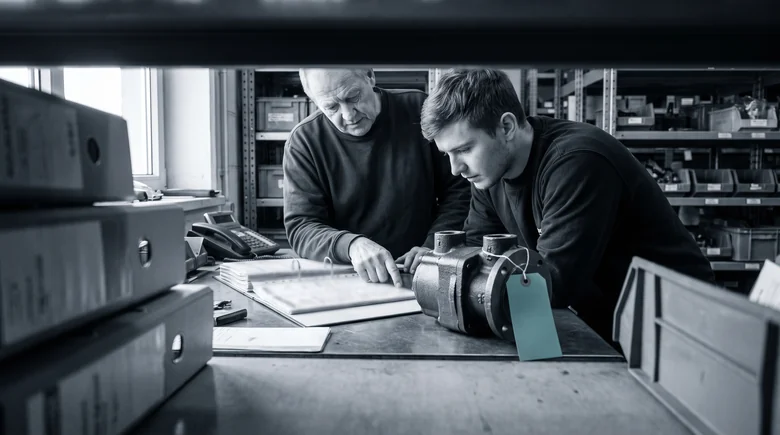
Picture a request arriving at the parts desk on a Thursday: a customer needs "the pump on the clamping unit" of an injection moulding machine built in 2005. The new colleague searches the catalogue for "pump clamping unit" and finds forty results, none of them obviously right. Across the desk, the colleague who has been there for twenty-six years glances at the machine number and says it is the internal gear pump from the second revision, listed under the supplier's number in the old parts list. It takes her a minute. She retires in March.
Every parts desk has a version of this person. When they leave, the catalogue stays, and so do the machines in the field. What goes with them is the route from a customer's words to the right part number, and the answer that walks out the door with the expert is the one the next customer will be waiting for.
The shortage lands on a few heads
The labour shortage is the service industry's own complaint. In the IFS State of Service 2025 report, 98% of service organisations say they face labour shortages. In the German service association's TrendRadar 2024, 62% of the companies surveyed believe AI can cover part of the gap. On the parts desk, the shortage has a particular shape. The desk rarely loses a whole team; it loses the one or two people who can still answer requests for the oldest machines, and nobody notices how much depended on them until the first request goes unanswered.
That knowledge is hard to see because it never shows up as work. The expert does not log a lookup when she recognises a part from a description. She knows, and the quote goes out the same day. The clarification round that would otherwise follow, back to the customer and to engineering, is described in from spare parts inquiry to quote. With the expert at the desk, it often never happens.
Four kinds of parts desk tribal knowledge
Parts desk tribal knowledge is not one thing. Sitting beside an expert for a few days, you see it come in four kinds, and each one needs a different home once she leaves:
- Which words mean which part. Customers say "the blue one" or "the pump on the clamping unit"; the catalogue says "internal gear pump, NG16". The expert translates between the two without noticing.
- What replaced what. Part numbers are superseded, merged and split over the years. The expert knows that the number in the 2005 parts list now leads to a newer pump, and which adapter it needs.
- Which machines were changed on site. A pump swapped for a larger one during a repair, a valve block from a different series. The drawing still shows the original. The expert remembers the exception.
- Where to look when the label is gone. A worn nameplate, a part without a number. The expert measures, compares the shape and knows which drawer, which old binder, which supplier.

The first and the last kind are where a catalogue can help most, because they are about finding. The middle two are about history, and they need to be written into the catalogue before they can be found in it.
A one-week exercise before the expert leaves
The fastest way to see what you are about to lose is to watch it happen. For one week, sit someone beside the expert, ideally the colleague who will take over. Every time a request goes through the expert's head rather than a system, they write down three things: what the customer said, what the expert answered, and where the answer came from. At the end of the week, sort the list into two groups: answers the catalogue could have given if it understood the customer's words, and answers that exist only in the expert's memory.
The second group is your knowledge-transfer plan. Those supersessions and site changes go into the records while the expert can still check them. The first group is a search problem, and it is usually the larger one.
Make the catalogue searchable the way the expert thinks
Every decision about a part, whether to repair, reorder, consolidate or replace it, depends on knowing what the part is. That knowledge is scattered across catalogs, labels and the heads of a few experts. We built one platform so that the technician, the planner and the buyer all work from the same understanding of the part.
Partium Find makes the first group searchable for the colleague who stays. Type what you know: a few words, a function, part of a description. Find searches by meaning, not by exact naming. "Pump on the clamping unit" becomes a starting point rather than forty results. The machine's history narrows it further. Use the bill of materials to narrow down a part that is hard to name. And when the request arrives with a photo or a label instead of words, the same search takes it. Partium Find identifies the spare part from whatever you have at the machine: a photo, a label, a code, a few words or the bill of materials.
The expert's last months are then spent where they matter most: on the judgement calls, and on checking that the catalogue now says what she knows. Run the one-week exercise first, then book a demo, or ask for the demo license and try it on the requests your expert answered that week.
See it on your own catalog.
Book a demo, or start with a demo license.