
Industrial organizations are not short on systems.
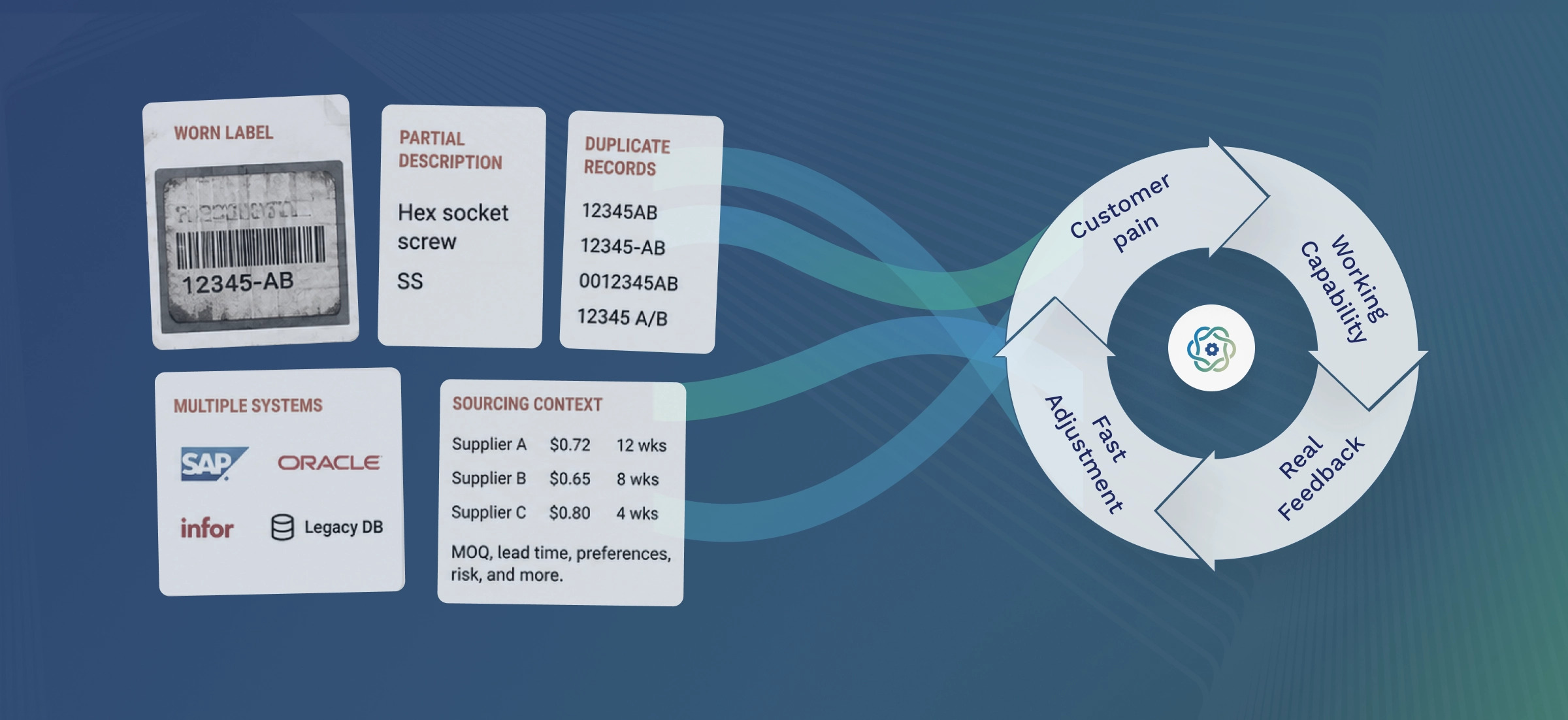
Most already have ERPs, EAMs, CMMS platforms, procurement tools, supplier portals, catalogs, spreadsheets, and years of internal knowledge spread across teams.
The problem is not always that the information does not exist.
The problem is that the information is often incomplete, inconsistent, scattered, duplicated, or hard to use when a decision needs to be made.
That matters because parts decisions rarely happen in perfect conditions.
A maintenance technician needs to identify a component while equipment is down.
A buyer needs to understand whether there are supplier options beyond the usual source.
A service team needs to help a customer find the right replacement part from a photo or partial description.
A planner needs to know whether two similar records are actually duplicate candidates.
A sourcing team needs pricing, availability, identifiers, and potential alternatives before a lead-time issue becomes urgent.
Each of those moments depends on part information.
But more importantly, each depends on part context.
That is where Parts Intelligence comes in.
The issue is not just bad data. It is decision friction.
For years, industrial organizations have talked about parts data as a master data problem.
Clean the records.
Normalize the descriptions.
Reduce duplicates.
Improve the catalog.
Standardize the naming.
Those efforts matter. But they do not fully solve the operational problem.
Because the business does not stop and wait for perfect data.
Maintenance still has to repair equipment.
Procurement still has to source the part.
Aftersales still has to respond to the customer.
Supply chain still has to manage availability, cost, and risk.
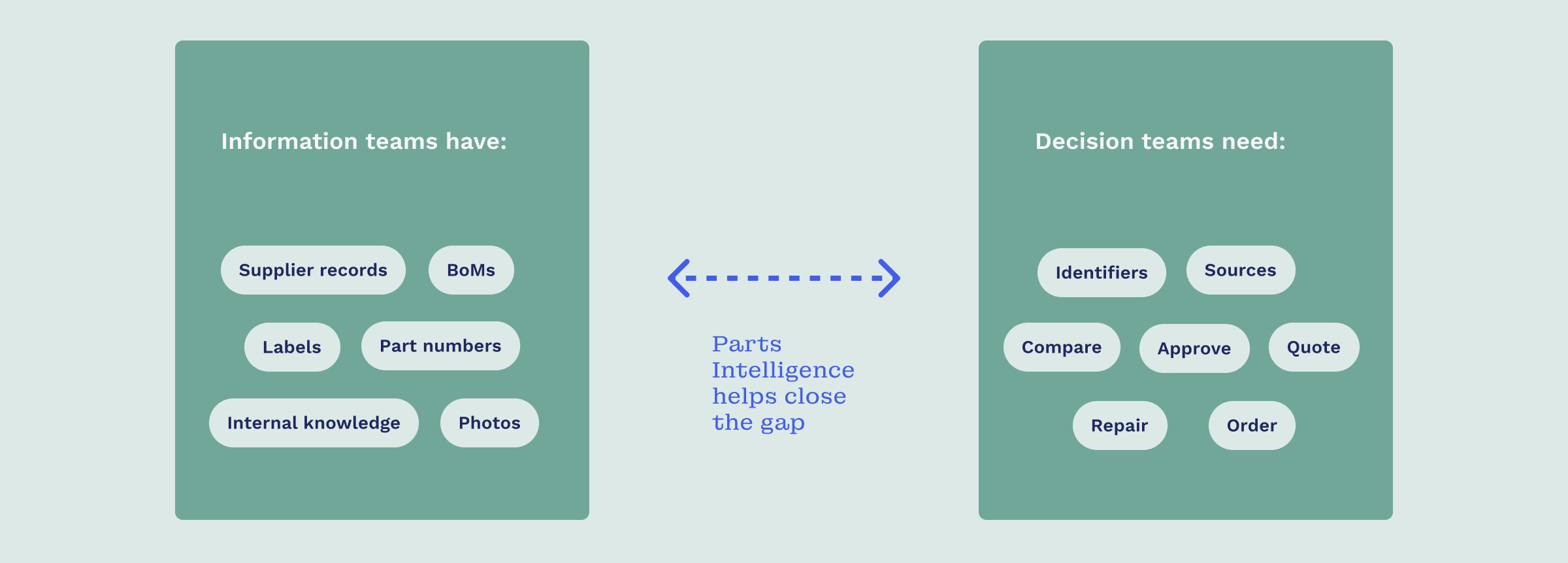
The gap is not only between clean and messy data.
It is between the information a team has and the decision they need to make.
That is the real problem Parts Intelligence helps solve.
Not data for its own sake.
Decision-ready part context.
Why this matters now
The timing matters because industrial teams are under pressure from several directions at once.
Supply chains are more volatile. Lead times can shift quickly. Supplier risk is harder to ignore. Procurement teams are being asked to move faster while still controlling cost, compliance, and risk.
MRO and maintenance teams are expected to reduce downtime without adding unnecessary inventory.
Aftersales teams are expected to improve service speed and customer experience while managing complex parts catalogs.
At the same time, AI is changing what teams expect from software.
But AI alone does not fix parts operations.
AI becomes valuable when it helps teams connect scattered part information to the decision in front of them.
That is why Parts Intelligence is not just another search tool or another data-cleanup project.
It is a way to make part information usable across the workflows where parts decisions actually happen.
Parts Intelligence for procurement and supply chain
For procurement and supply chain teams, the part record is often the starting point for a sourcing decision.
But too often, that record is incomplete.
The identifier may be missing.
The supplier number may not match the manufacturer number.
The OEM may be the only known source.
Pricing may be outdated.
Availability may be unclear.
Potential alternatives may not be visible.
Duplicate candidates may be hiding in the system.
When that happens, supplier discovery starts from a weak position.
The team may default to the known source, search manually across supplier sites, ask around internally, or delay the decision while trying to understand what the part actually is.
That is not a supplier problem alone.
It is a part context problem.
For sourcing teams, Parts Intelligence helps reduce that friction.
The goal is not to guarantee a cheaper part or replace procurement judgment.
The goal is to give teams better context before they make the sourcing decision:
- clearer identifiers
- connected manufacturer and supplier references
- pricing and availability context
- supplier options
- duplicate candidates
- potential part alternatives
- fewer blind defaults to the usual source In a world where supplier discovery matters more, the ability to understand the part itself becomes a competitive advantage.
Parts Intelligence for MRO and maintenance
For MRO and maintenance teams, part decisions are often tied directly to uptime.
The question is rarely abstract.
It is practical:
What is this part?
Do we already have it?
Is this the right replacement?
Is there a duplicate record?
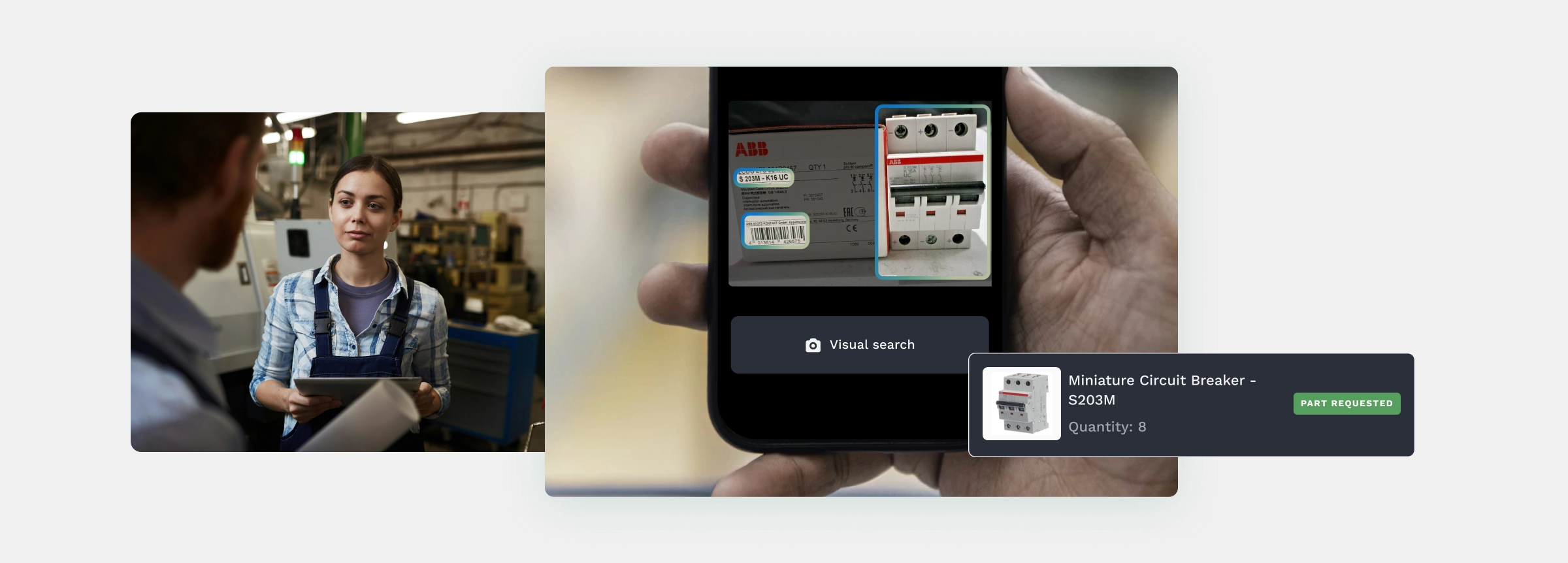
Can we identify it from a photo, label, code, or partial description?
Can the technician keep working, or does the process turn manual?
The problem is that many maintenance environments do not begin with perfect inputs.
A technician may have a worn label.
A part may be installed in a hard-to-reach location.
A code may be partial.
The description in the system may not match the words used in the field.
The person who knows the part may not be available.
When systems cannot work with those imperfect inputs, the workaround becomes human.
Ask the experienced technician.
Walk to the storeroom.
Compare similar parts.
Search old work orders.
Take multiple parts just in case.
Wait for confirmation.
That is why Parts Intelligence for maintenance is not only about search speed.
It is about keeping the process digital before it turns manual.
Parts Intelligence for aftersales and service
Aftersales teams face a different version of the same problem.
A customer does not always know the correct part number.
They may send a photo.
They may describe what broke.
They may reference a machine model.
They may say it looks like a part they bought years ago.
They may have a label that is scratched, dirty, or incomplete.
The service team then has to translate that incomplete information into the right replacement part.
If that process is slow or uncertain, the impact is immediate:
- slower quotes
- delayed orders
- more back-and-forth with customers
- higher risk of wrong-part recommendations
- more returns
- lost service revenue
- lower customer confidence
For aftersales, part identification and part confidence are commercially important.
The goal is not just to show a list of similar items.
The goal is to help the customer get the right part.
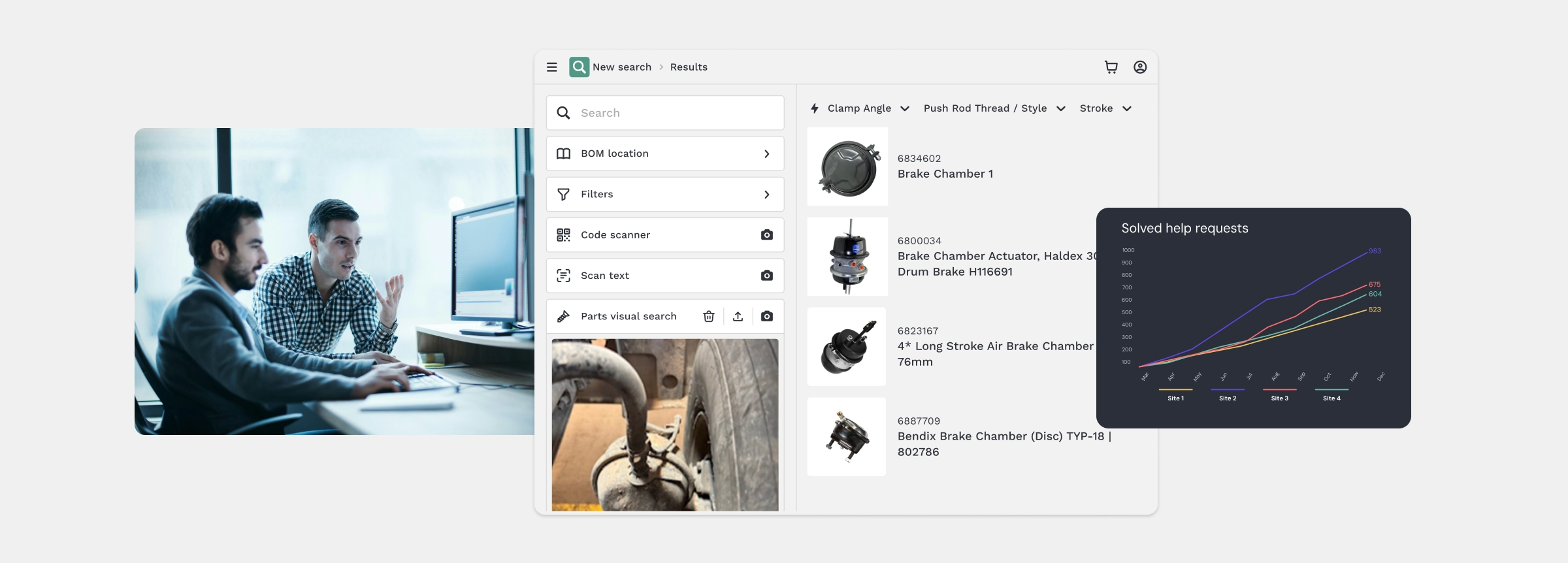
Parts Intelligence helps service teams move from incomplete customer input to a more confident part decision.
Why traditional systems are not enough
ERP, EAM, CMMS, PIM, procurement, and eCommerce systems are essential.
But they were not always designed to answer messy parts questions in real time.
They often work best when the user already knows the right input:
- exact part number
- exact description
- exact equipment reference
- exact supplier name
- exact manufacturer number
- exact category
- exact search term
But many parts decisions start before those inputs are known.
That is why the next layer has to be more flexible.
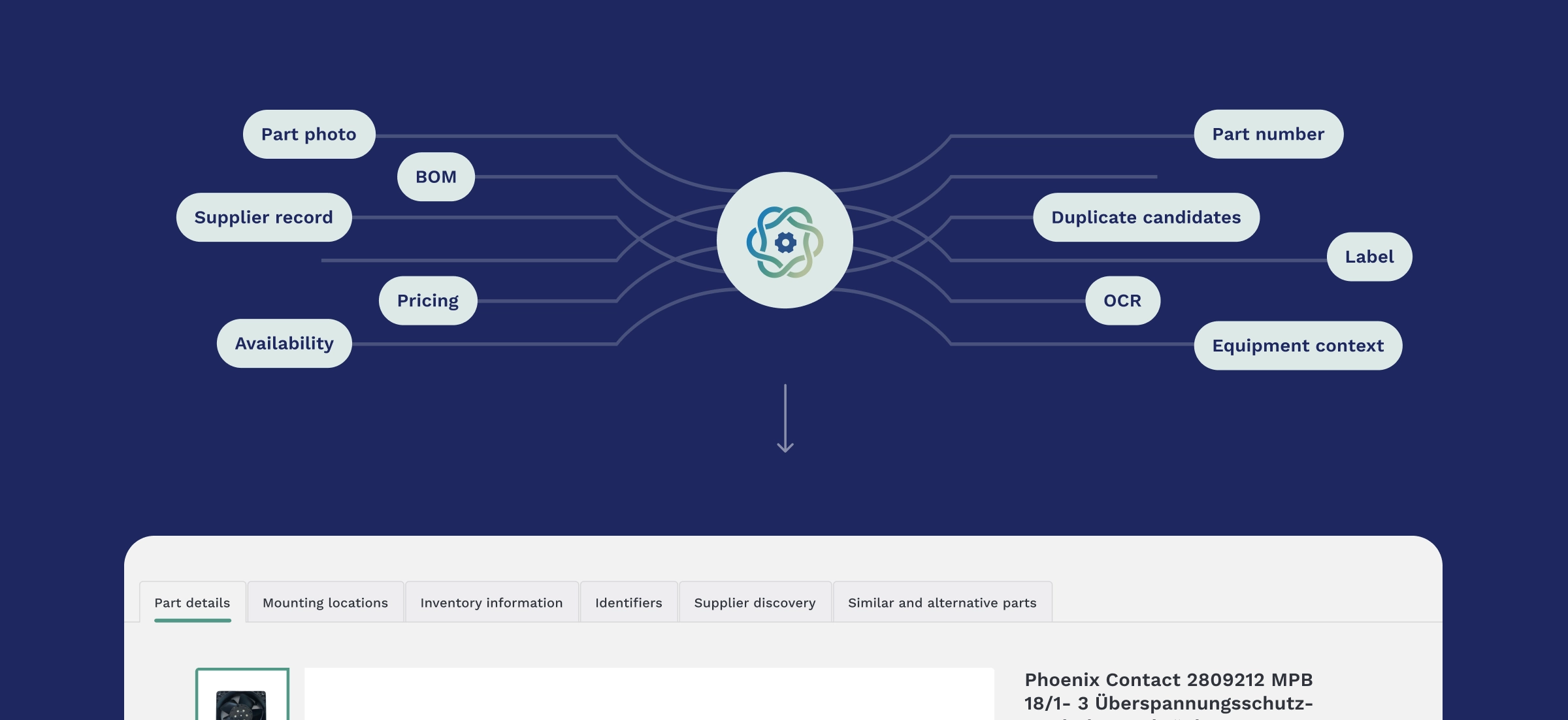
It has to understand different types of part information:
- visual input
- semantic text
- OCR from labels
- scanned codes
- BoM context
- equipment context
- supplier references
- manufacturer identifiers
- historical part knowledge
- duplicate candidates
- pricing and availability signals
- potential alternatives
The value is not AI as a buzzword.
The value is helping people make better parts decisions with the information available.
What Parts Intelligence actually means
Parts Intelligence is the layer that connects part search, part context, and part decisions.
It helps teams move from partial information to a more confident next step.
That could mean identifying the right part from a photo.
Reading a worn label.
Connecting a part to BoM context.
Finding supplier options.
Comparing pricing and availability.
Flagging duplicate candidates.
Completing missing identifiers.
Surfacing potential part alternatives.
Helping a customer, technician, buyer, or planner make a better decision faster.
This is bigger than search alone.
Search helps teams find.
Parts Intelligence helps teams understand what they found and what they can do next.
The role of Partium
Partium is built around this shift.
Partium Find helps teams identify the right part from the information available in the moment: photos, labels, codes, descriptions, filters, BoM context, and existing part knowledge.
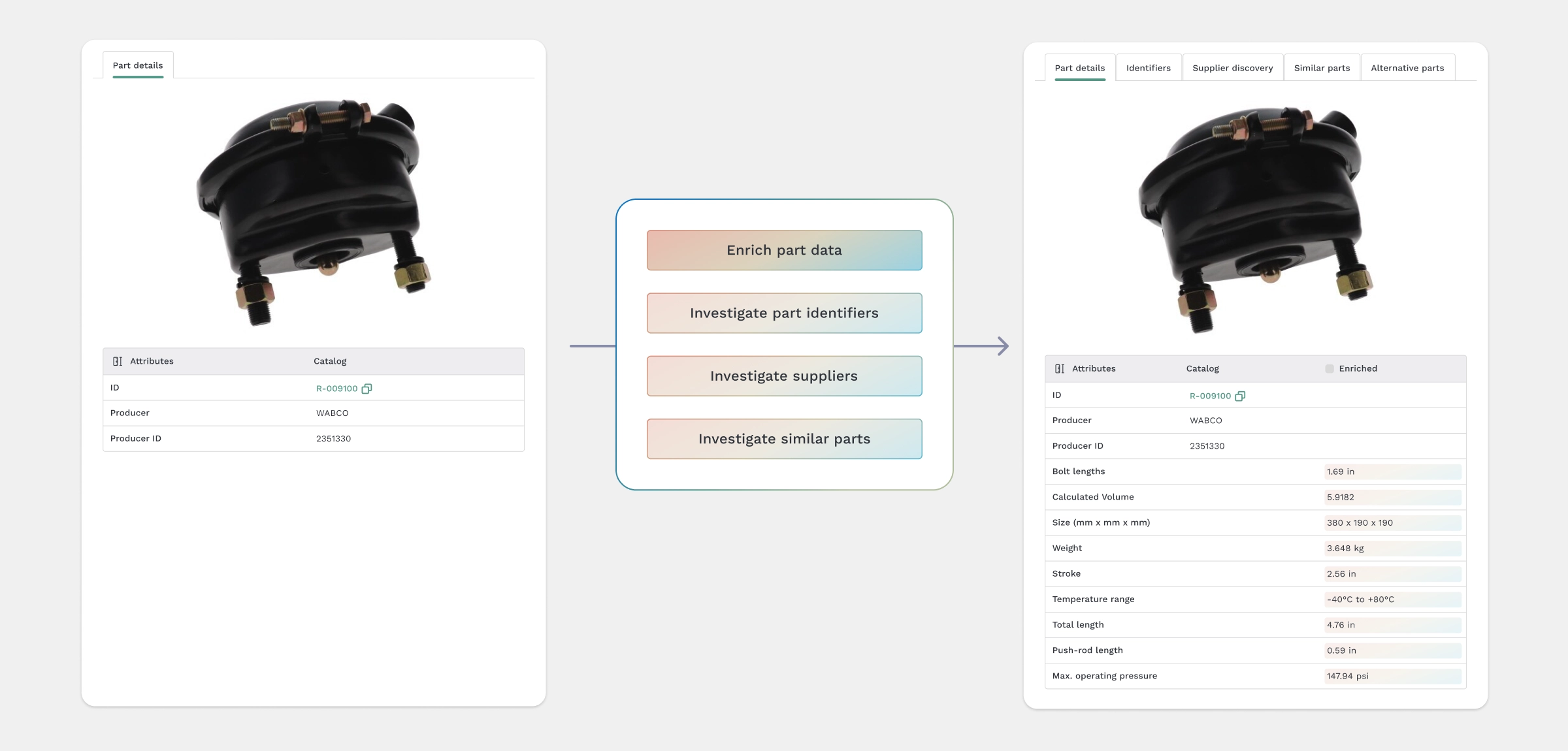
Partium Agent helps teams move from incomplete part records to decision-ready sourcing context by filling missing identifiers, comparing supplier pricing and availability, flagging duplicate candidates, and surfacing supplier options and potential part alternatives.
Together, Find and Agent support the broader Parts Intelligence workflow:
Find the right part.
Complete the part context.
Move toward a better decision.
That matters because the part decision is rarely isolated.
It affects maintenance speed.
It affects sourcing options.
It affects inventory.
It affects service response.
It affects customer confidence.
It affects lead-time risk.
The future of parts operations is not more data. It is better context.
Industrial teams already have data.
What they need is usable context at the moment the decision happens.
That is the opportunity for Parts Intelligence.
For procurement and supply chain, it means better supplier discovery and sourcing visibility.
For MRO and maintenance, it means faster identification and less manual work when equipment is down.
For aftersales and service, it means helping customers and teams move from incomplete information to the right replacement part faster.
The companies that improve this layer will not just have cleaner records.
They will make better parts decisions.
And in industrial operations, better parts decisions show up everywhere:
less waiting
less manual searching
better sourcing options
fewer duplicate candidates
faster service response
more confident maintenance execution
less lead-time risk
Parts Intelligence is not about replacing the systems industrial teams already use.
It is about making the part information inside and around those systems usable when it matters most.