
When companies evaluate new technology, one question comes up quickly:
What evidence do we have that customers need this?
It is the right question.
No one wants innovation theater. No one wants another AI feature looking for a business problem. Enterprise teams need proof that a new capability solves something real.
But in an emerging category, the evidence is not always waiting upfront.
Sometimes, it has to be built.
That is especially true in Parts Intelligence.
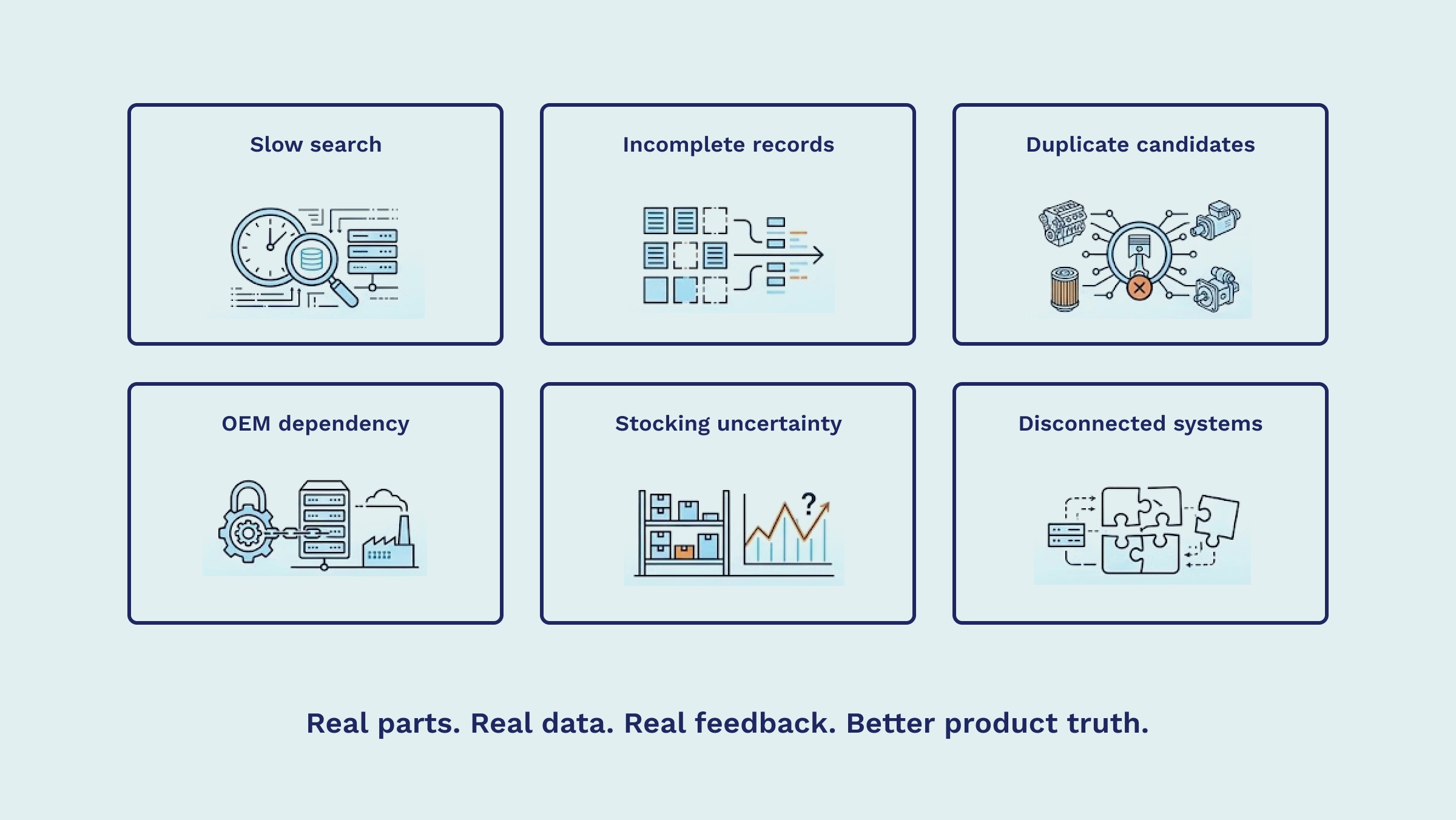
Industrial teams know the problems well: slow part search, incomplete data, duplicate records, OEM dependency, long lead times, stocking uncertainty, and low confidence in the systems they use every day.
But the exact solution is still being defined.
That is where real-world proof-of-concepts matter.
Not as demos. Not as sales exercises. Not as polished lab tests.
As learning environments where customer pain meets real product capability.
Mature Categories Are Easier to Compare
In a mature software category, customers can often compare known solutions.
They know what a CRM is supposed to do. They know what an ERP does. They know what a CMMS is designed to manage. They know what procurement software usually supports.
The evaluation becomes easier to structure:
- Which vendor has the right features?
- Which system integrates best?
- Which implementation timeline is realistic?
- Which pricing model fits?
- Which reference customers can prove success?
That does not mean buying is easy. Enterprise software buying is never exactly a walk in the park. More like a walk through six stakeholder committees carrying a spreadsheet.
But at least the category is familiar. The buyer has a mental model.
In an emerging category like Parts Intelligence, the work is different.
Customers understand the pain. The market understands the pressure. But the solution category is still taking shape.
That means customers may not always be able to describe exactly what the product should become.
And that is not a weakness. That is the work.
Customers Bring the Pain
Customers do not need to invent the solution for the pain to be valid.
A maintenance team may not ask for multimodal AI search. They may say, “Our technicians spend too much time finding the right spare part.”
A procurement team may not ask for an AI-powered parts intelligence layer. They may say, “We rely too heavily on OEMs because we do not have enough confidence in alternatives.”
A supply chain team may not ask for relationship-setting between parts. They may say, “We have duplicates, inconsistent records, and no clear way to trust what is in the system.”
A master data team may not ask for an agentic workflow. They may say, “We are constantly cleaning descriptions, manufacturer numbers, and part records manually.”
Those are not just complaints. They are signals.
They tell us where the work breaks. They show where friction is hiding. They reveal which decisions are harder than they should be.
This lines up with the Jobs to Be Done view of innovation: instead of building around surface-level feature requests, companies need to understand the progress customers are trying to make and the job they need to get done.
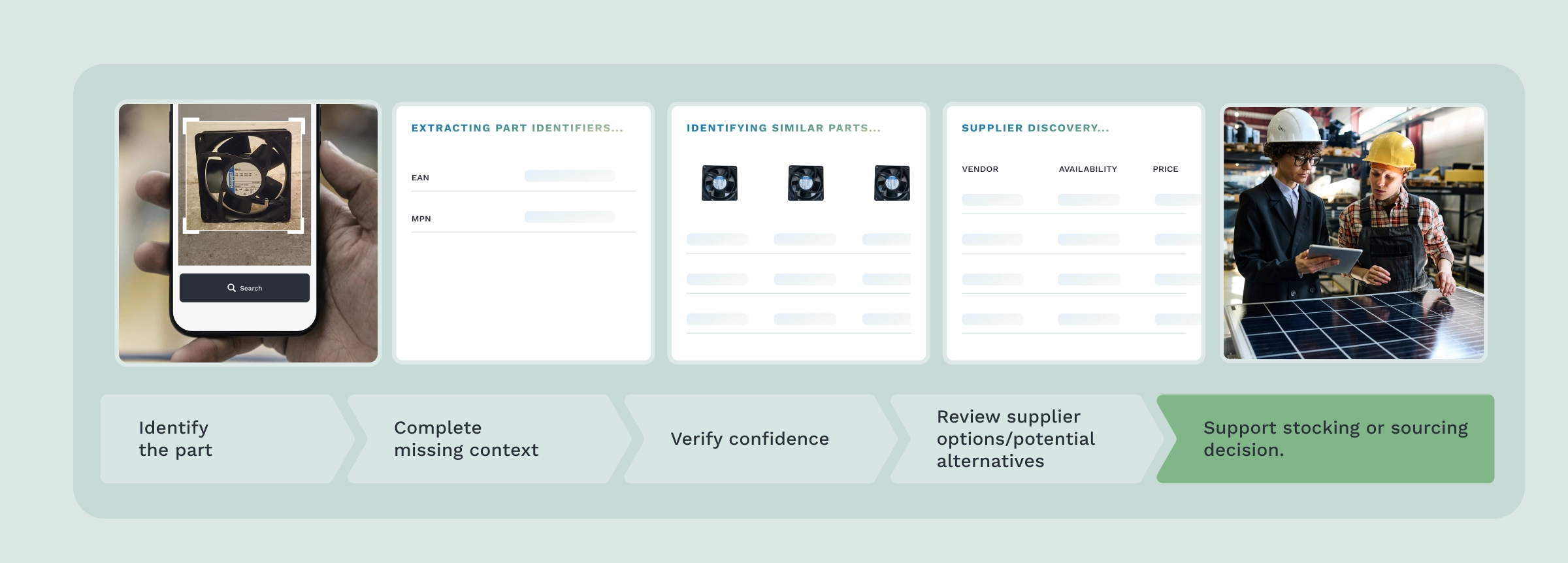
For industrial teams, the job is not simply “find a part.”
The job is bigger:
- Find the right part.
- Trust the data.
- Understand what is missing.
- Know whether there are potential alternatives.
- Make a better sourcing or stocking decision.
- Keep operations moving.
That is the real job. And it is not solved by search alone.
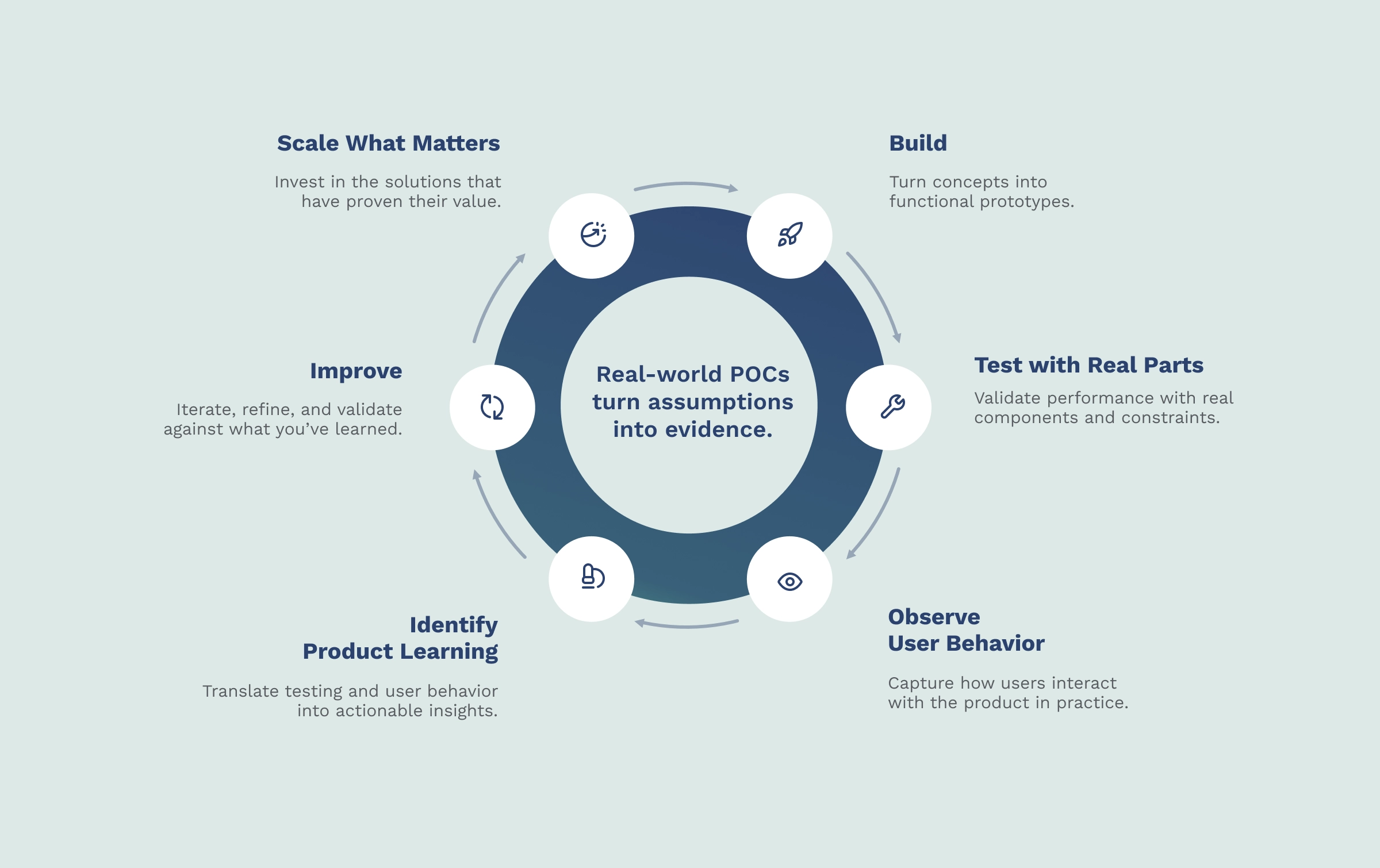
POCs Reveal What the Solution Needs to Become
This is why POCs matter so much in an emerging category.
A weak POC asks: Can we show something impressive?
A strong POC asks: Can this create value in the customer’s real environment?
That distinction matters.
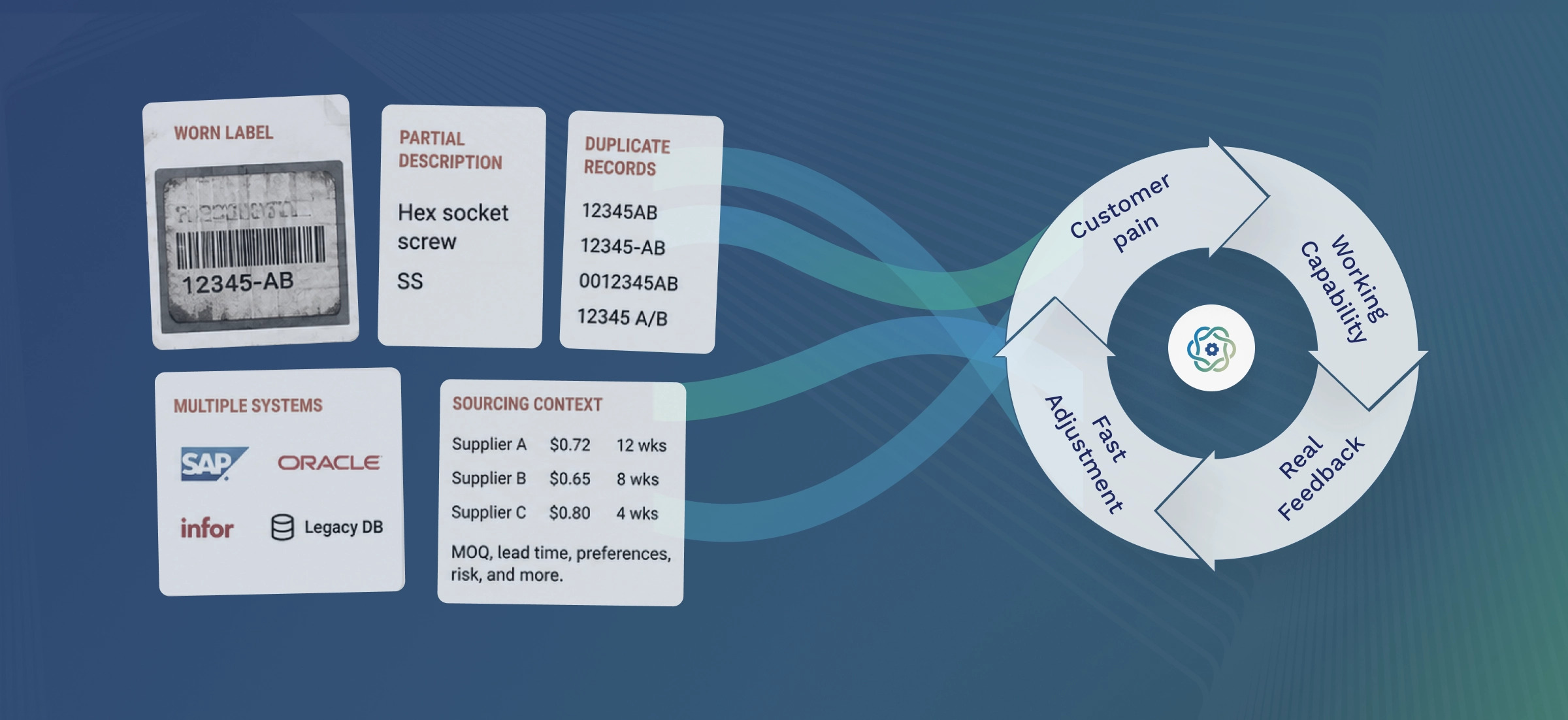
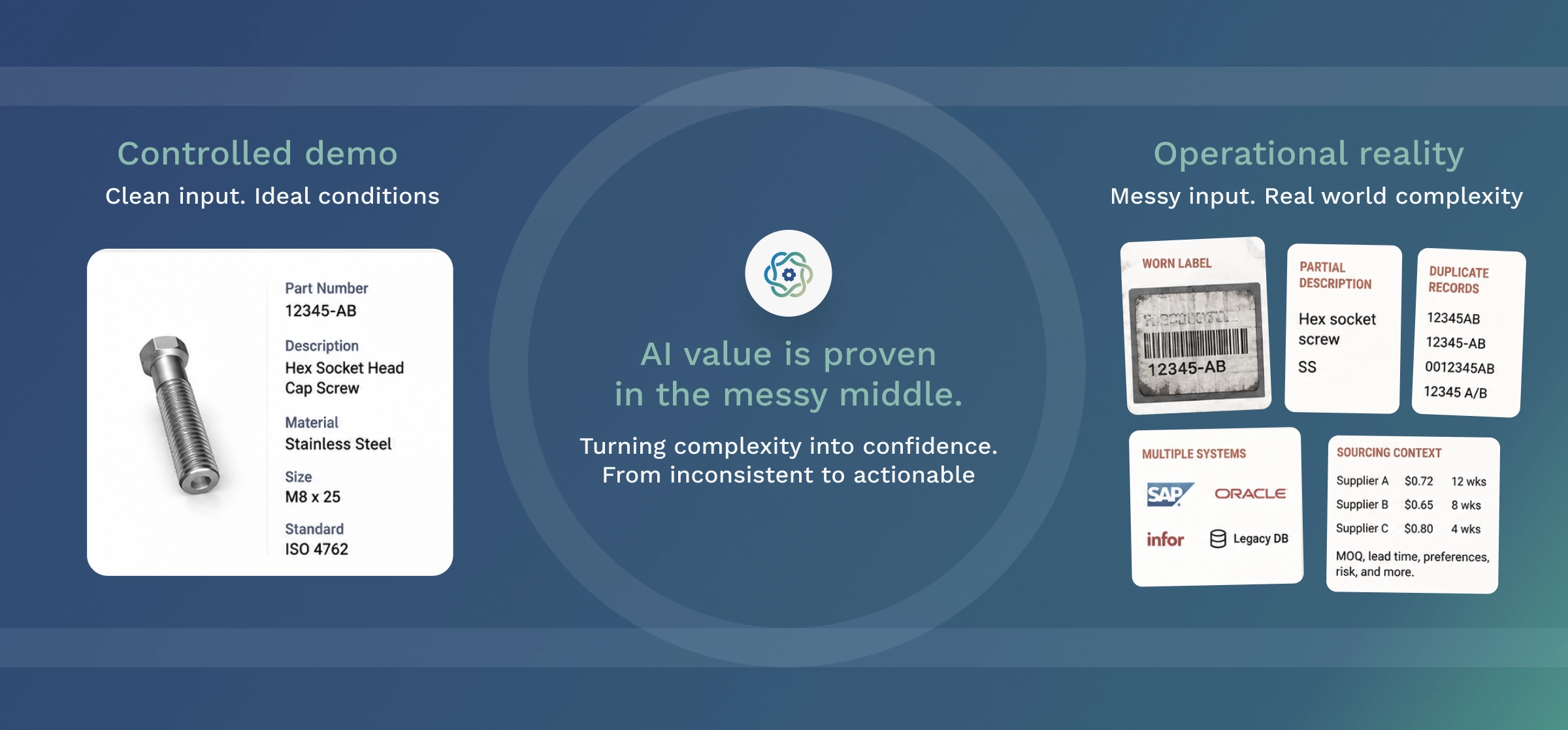
Because in industrial parts, the real environment is rarely clean.
- Part descriptions are incomplete.
- Manufacturer numbers may be missing.
- Duplicates exist across systems.
- Images may be poor or unavailable.
- Different locations may use different naming conventions.
- ERP and CMMS data may be technically present but not practically useful.
- Users may rely on tribal knowledge because the system cannot be trusted on its own.
That is the operating reality. So the proof has to happen there.
With real parts. Real data. Real workflows. Real constraints. Real users trying to solve real business problems.
A POC should not only prove whether today’s product works. It should reveal what the product needs to become.
AI Demos Are Easy. Operational Value Is Harder.
This is especially important in AI.
The market is flooded with AI demos. Some are impressive. Some are useful. Some are just a chatbot wearing a hard hat.
But enterprise AI does not succeed because it performs well in a controlled demo.
It succeeds when it can handle operational complexity: messy data, fragmented systems, risk controls, user trust, workflow fit, and measurable business value.
Gartner has predicted that at least 30% of generative AI projects will be abandoned after proof of concept by the end of 2025, citing issues such as poor data quality, inadequate risk controls, escalating costs, and unclear business value.
McKinsey’s 2025 State of AI research also shows that while AI use is expanding, many organizations are still in experimentation or pilot phases, with the move from pilots to scaled enterprise impact remaining difficult for many companies.
That is the lesson. A POC is not the finish line. It is where the serious questions begin.
- Can the system work with our data?
- Can users trust the output?
- Can it fit into existing workflows?
- Can it support better decisions?
- Can it scale beyond one controlled example?
- Can it create value when the data is imperfect?
For Parts Intelligence, those questions are central. Because the goal is not to prove that AI can respond. The goal is to prove that AI can help industrial teams make better parts decisions.
What a Good Parts Intelligence POC Should Prove
A good POC should not try to prove everything. That is how pilots become bloated, unfocused, and impossible to evaluate.
Instead, a strong Parts Intelligence POC should focus on a few meaningful questions.
1. Can teams identify the right part faster?
This is often the most visible source of friction. If technicians, planners, buyers, or service teams spend too long searching, the cost is not just time. It affects maintenance efficiency, service speed, confidence, and operational flow.
The question is not only: Can the system search? The better question is: Can the system help people get to the right answer faster, even when the input is incomplete?
2. Can the system improve confidence in parts data?
Search is only useful if the result can be trusted. If the part record is incomplete, duplicated, poorly described, or missing key manufacturer information, users hesitate. And when users hesitate, they often fall back on manual workarounds, colleagues, or OEM support.
A good POC should reveal whether the system can help improve confidence in the data, not just display another result.
3. Can it support better sourcing flexibility?
OEMs are important. In many cases, they are necessary. But unnecessary OEM dependency can limit flexibility, availability, and decision-making.
A Parts Intelligence POC should help reveal where better data, identification, and enrichment can support more informed sourcing discussions, including potential alternatives where appropriate.
This is not about promising that every part will cost less. That would be lazy marketing and probably wrong. It is about improving visibility, context, and confidence so teams can make better purchasing decisions.
4. Can it support stocking and availability decisions?
Stocking decisions are difficult when part records are unreliable. If parts are duplicated, poorly classified, inconsistently named, or missing key data, it becomes harder to understand what is actually needed, where risk exists, and how inventory decisions should be made.
A good POC should show whether better parts intelligence can support smarter stocking conversations. Not by replacing human judgment. By giving teams better information to work with.
5. Can the learning become product?
Not every POC insight should become a feature. Some requests are one-off. Some edge cases are interesting but not scalable. Some ideas sound useful until they meet the real workflow.
The purpose of a POC is not to collect every possible customer request. The purpose is to understand which patterns matter enough to become part of the enterprise product. That is how a category becomes disciplined instead of noisy.
Proof Is Built Through Learning
There is a reason the Lean Startup methodology emphasizes validated learning: build something, measure what happens, and learn whether to continue, change direction, or stop.
That idea matters in enterprise AI, but it needs to be applied with industrial seriousness.
For Parts Intelligence, learning does not happen in a generic sandbox.
It happens close to the customer’s real operations.
It happens when the system meets incomplete records, messy naming conventions, poor images, missing manufacturer numbers, disconnected systems, and users who need answers under pressure.
That is where assumptions become evidence. That is where the product gets sharper. And that is where the category earns trust.
The Real Value of a POC Is Focus
The best POCs do more than validate a product.
They sharpen the problem.
- They reveal what matters most.
- They show where the data breaks.
- They expose workflow constraints.
- They uncover hidden risks.
- They separate valuable capabilities from interesting distractions.
That last point matters. Enterprise teams do not need more AI noise.
They need useful intelligence that helps them make better decisions in the flow of work.
So the standard cannot be: Can we build it?
The better standard is: Does this help the customer make a better parts decision?
If the answer is yes, keep going. If the answer is no, learn faster.
Parts Intelligence Has to Be Proven in the Real World
Parts Intelligence is emerging because industrial teams are under pressure from every direction.
- They need faster identification.
- They need cleaner and more complete data.
- They need better visibility into sourcing options.
- They need stronger stocking decisions.
- They need less manual work.
- They need systems that support decisions, not just store records.
But those improvements do not happen because a vendor says “AI.”
They happen when new capabilities are tested against real customer pain.
That is the role of the POC.
It turns assumptions into evidence. It turns customer pain into product learning. It turns a vision into something that can be evaluated, improved, and scaled.
In a mature software category, customers can often compare known solutions.
In an emerging category like Parts Intelligence, the work is different.
Customers bring the pain.
POCs help reveal what the solution needs to become.
And sometimes, in a new category, that is exactly how the proof gets built.