

A maintenance delay rarely begins at the exact moment the equipment stops.
It often starts earlier.
It starts when a part is hard to identify.
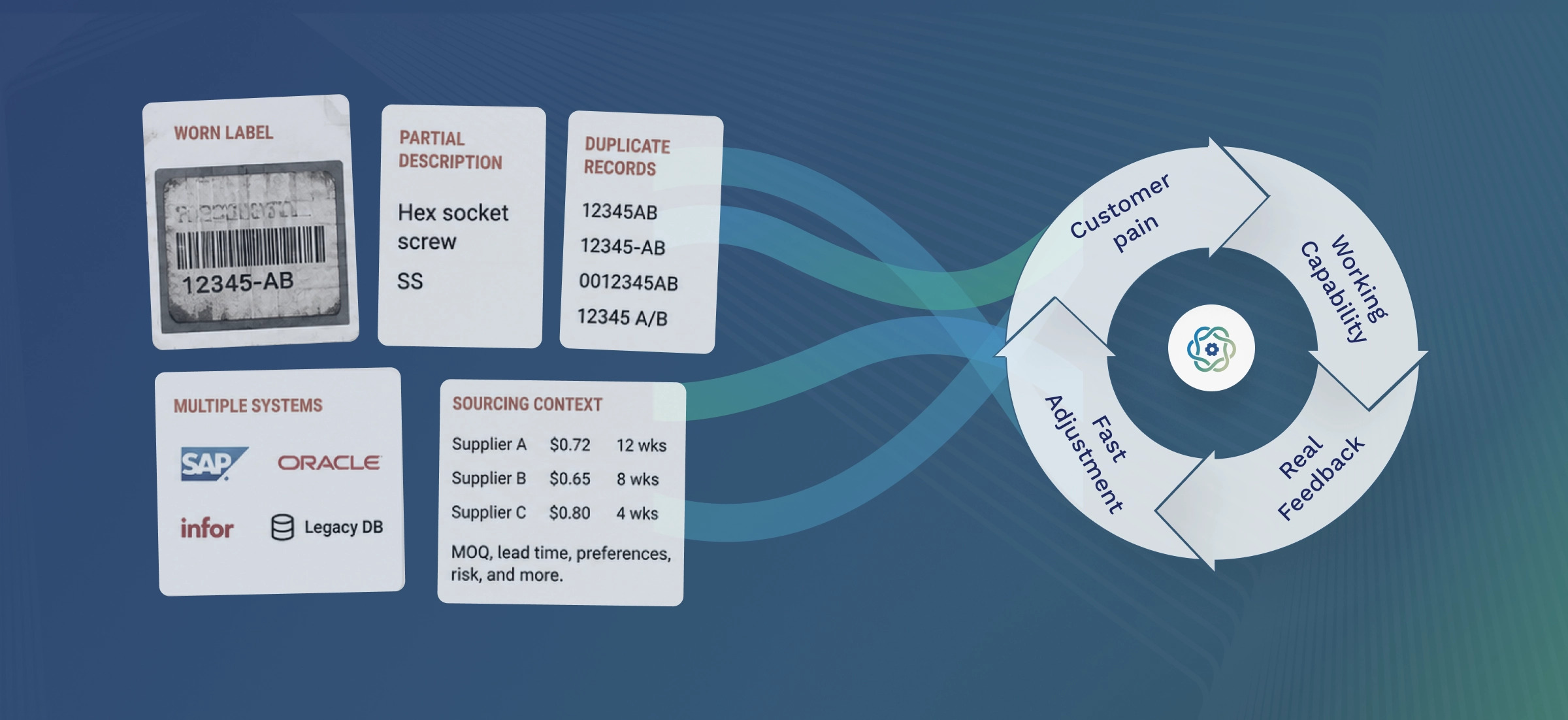
When the label is worn.
When the description in the system does not match what the technician sees.
When the same part may exist under more than one record.
When inventory is unclear.
When availability has to be checked manually.
When the buyer is not sure which supplier number connects to which manufacturer number.
By the time maintenance is waiting, the parts problem has already become operational.
That is why the title matters: maintenance does not wait for data. It waits for the right part.
Not more screens. Not more disconnected records. Not more manual searching.
The right part, with enough context to act.
Maintenance delays often start before maintenance begins
When people talk about MRO delays, the conversation often moves quickly to labor, capacity, service schedules, supplier performance, or inventory levels.
Those are real issues.
But there is another bottleneck that is easier to miss: the part decision itself.
What is this part?
Is it the right replacement?
Do we already have it?
Is this record a duplicate candidate?
Can it be sourced from another supplier?
Is the availability current?
Is there enough confidence to move forward?
If those questions are unclear, the work slows down.
The technician waits.
The planner checks another system.
The buyer searches manually.
Someone asks the experienced person who usually knows.
The repair does not move because the part decision is not ready.
That is the hidden delay inside many MRO workflows.

MRO is a parts supply chain, not just a maintenance function
MRO is often discussed as a maintenance discipline, but the work depends on a supply chain of parts, suppliers, inventory, service coordination, and decisions.
IBM defines the MRO supply chain as the sourcing, procurement, and management of the parts and equipment needed to keep industrial equipment running. It also describes spare parts procurement, MRO inventory management, and MRO service coordination as core parts of that supply chain.
Source: https://www.ibm.com/think/topics/mro-supply-chain
That definition matters because it makes the real problem clearer.
Maintenance performance is not only about how quickly someone can do the repair.
It is also about whether the organization can identify, confirm, find, source, and trust the part before the work stalls.
A technician may know something is broken.
A planner may know a work order is urgent.
A buyer may know the usual supplier has a long lead time.
But if the part information is incomplete, the entire process becomes harder than it needs to be.
That is where MRO delays become parts intelligence problems.

The part may exist, but still be hard to use
One of the most frustrating parts of MRO is that the answer may already exist somewhere.
The part may be in inventory.
The record may exist in the ERP.
A supplier number may be attached to an old purchase order.
A similar part may be listed under another description.
The image may be in a catalog.
The right context may live in the head of someone who has been there for years.
But if that information is scattered, incomplete, or hard to connect, the team still has to search manually.
That is where time disappears.
A worn label turns into a phone call.
A partial description turns into a long search.
A duplicate candidate turns into confusion.
A missing identifier turns into supplier uncertainty.
A delayed sourcing decision turns into equipment waiting.
The problem is not always that the data does not exist.
The problem is that the team cannot use it quickly enough when maintenance needs to move.
Parts availability is becoming a bigger MRO issue
This is not just an internal operations problem. Parts availability and MRO capacity are becoming more visible across industry.
IATA recently called for urgent action to ease engine MRO bottlenecks, pointing to engine durability issues, spare parts shortages, limited spare engine availability, and constrained aftermarket access as factors disrupting airline operations. IATA also said airlines need better access to spare parts, more approved repair options, fair access to MRO capacity, and greater aftermarket competition.
That example is aviation-specific, but the underlying issue is broader.
When parts availability is constrained, the ability to understand and act on part information becomes more important.
Teams need to know what the part is.
They need to know whether inventory exists.
They need to know whether the usual supplier is the only practical option.
They need to know whether there are supplier options or potential alternatives worth reviewing.
They need to know enough to make the next decision faster.
IATA has also called for better integration between maintenance systems and external market intelligence to improve inventory management, identify material availability and scarcity, support repair-or-replace decisions, and reduce manual work with AI.
That is the direction MRO is moving: less isolated information, more connected context.
AI can help, but only when the part context is usable
AI is becoming part of the supply chain and maintenance conversation, but it should not be treated like magic.
The Financial Times recently wrote that AI can help supply chains by synthesizing complex, cross-functional data into actionable insight. But the same article also noted that effective AI deployment depends on digital readiness, cohesive data, clear performance metrics, and trust.
Source: https://www.ft.com/content/3f773f4b-efaf-4bb4-953a-ff19863b2973
That distinction matters in MRO.
AI does not help much if it is working from weak part context.
If the part record is incomplete, the system has less to work with.
If supplier numbers and manufacturer numbers are disconnected, comparison becomes harder.
If duplicate candidates are not visible, the team may miss existing inventory or split demand across records.
If pricing and availability are scattered, the buyer still has to piece together the picture manually.
For MRO, AI becomes useful when it helps teams turn messy part information into a clearer decision.
Not when it simply adds another layer of output.
The right part decision has several steps
Finding the right part is not always one action.
It can involve several smaller decisions:
- Can we identify the part from the information available?
- Can we confirm it is the correct replacement?
- Do we already have it in inventory?
- Is there another record that points to the same part?
- Can we see supplier pricing and availability?
- Are there supplier options or potential alternatives to review?
- Is there enough confidence to move the work forward?
Every unclear answer creates friction.
And in maintenance, friction becomes waiting.
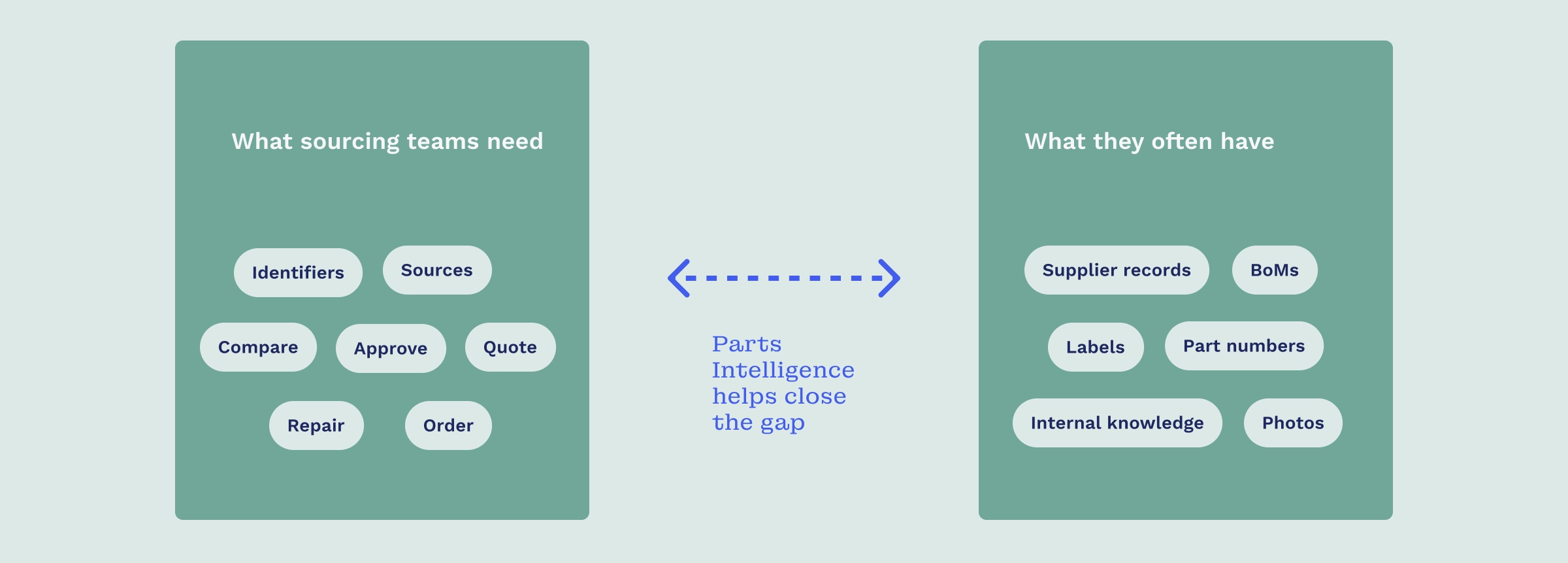
That is why MRO teams do not just need more data.
They need the right part context at the moment the decision has to be made.
Where Partium fits
Partium is built around this problem.
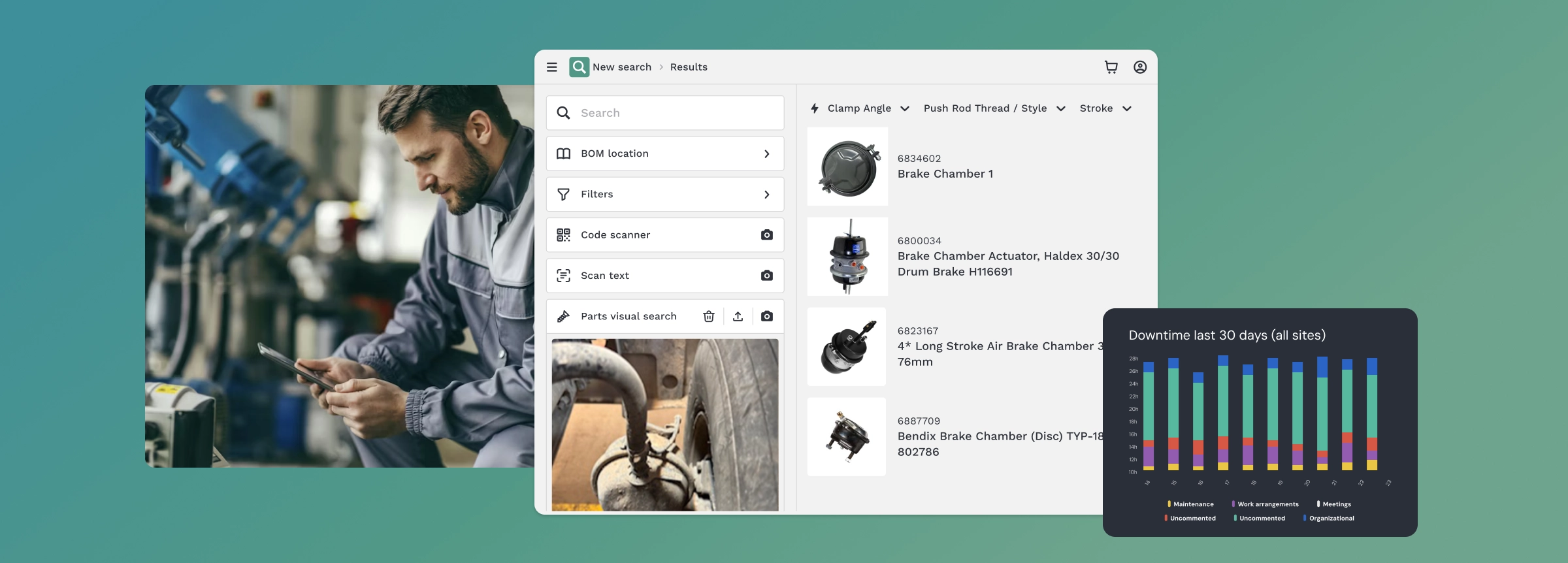
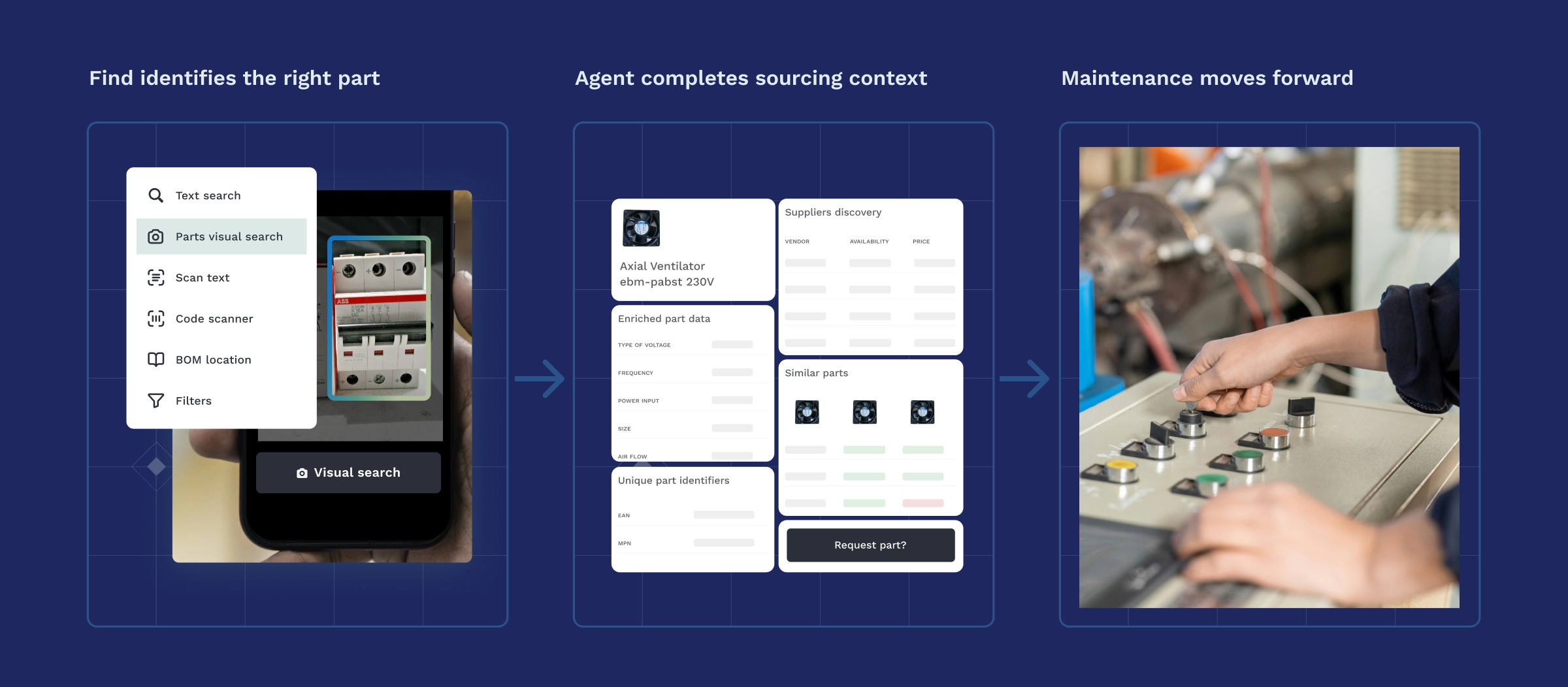
Partium Find helps teams identify the right part from the information available in the moment: photos, labels, codes, descriptions, filters, BoM context, and existing part knowledge.
That matters because maintenance rarely starts with perfect inputs.
A technician may have a photo.
A label may be worn.
A part number may be incomplete.
The description in the system may not match the words used in the field.
Partium Agent helps teams move from incomplete part records to decision-ready sourcing context by filling missing identifiers, comparing supplier pricing and availability, flagging duplicate candidates, and surfacing supplier options and potential part alternatives.
That matters because identifying the part is only one step.
The team may still need to understand availability, sourcing options, duplicate candidates, and whether there are potential alternatives worth reviewing.
Together, Find and Agent help MRO teams move from unclear part information to a better part decision.
The goal is not to replace maintenance judgment.
The goal is to reduce the manual search that happens before maintenance can move.
The future of MRO is less waiting, not more searching
Maintenance teams do not need more disconnected information.
They need the right information to come together when the work is waiting.
They need part identification that works with imperfect inputs.
They need inventory and sourcing context that is easier to trust.
They need duplicate candidates surfaced before confusion slows the process.
They need supplier options and potential alternatives visible before lead time becomes the emergency.
Most of all, they need the part decision to become clearer, faster.
Because maintenance does not wait for data.
It waits for the right part.