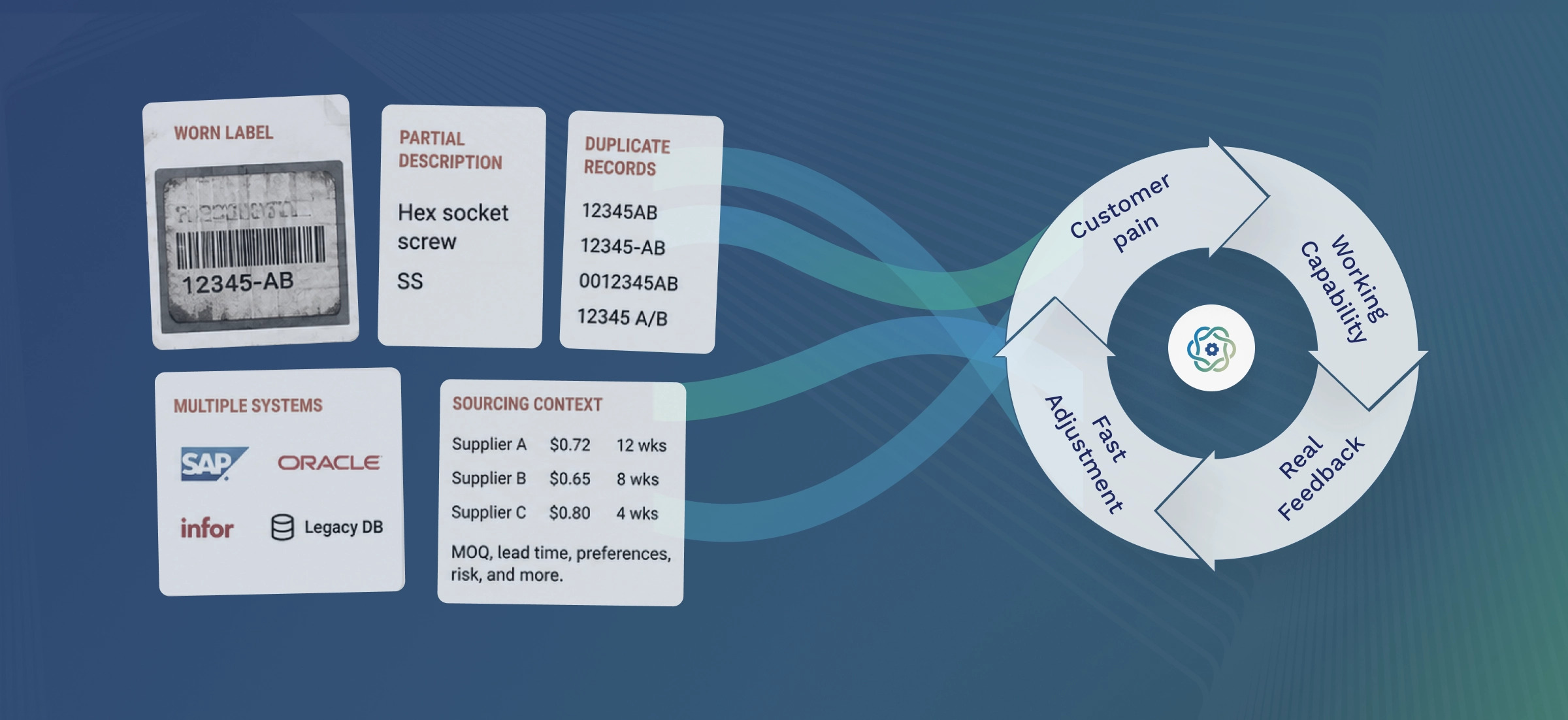


A customer rarely begins an aftersales conversation with perfect parts information.
They may not know the part number.
They may not know the correct name.
They may have a photo.
They may have a worn label.
They may know the equipment model, but not the component.
They may describe what broke instead of what needs to be ordered.
They may say, “It looks like this.”
And from that imperfect starting point, the service team is expected to make a confident recommendation.
That is the hidden work of aftersales.
It is not just answering a request.
It is translating incomplete customer information into the right replacement part.
When that translation works, the experience feels simple.
When it does not, everything slows down.
The customer waits.
The service team searches.
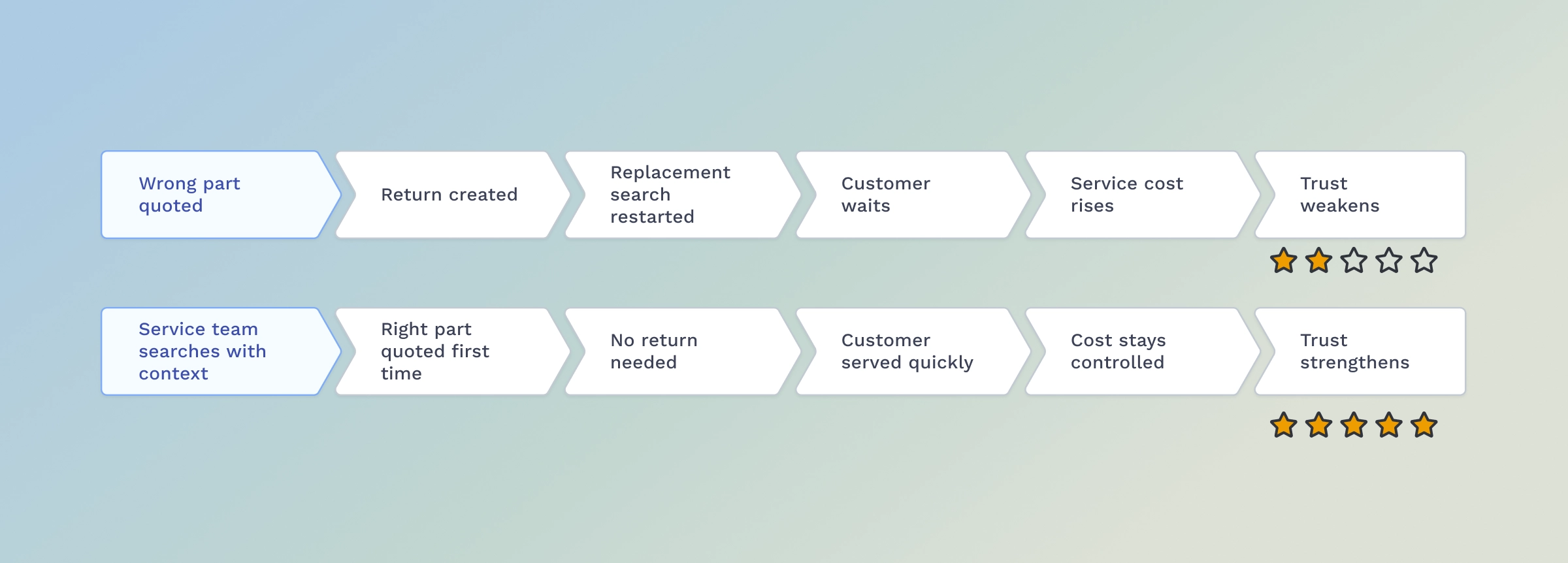
The wrong part may be quoted.
The order may be delayed.
A return may be created.
A technician may arrive without what they need.
The customer may lose confidence before the repair even begins.
In aftersales, the right part is not a small detail.
It is often the customer experience.
Aftersales is becoming a bigger competitive arena
For industrial companies, aftermarket and service are no longer back-office functions.
They are increasingly where differentiation, profitability, and customer loyalty are won or lost.
McKinsey has written that AI is already reshaping aftermarket and services by changing customer expectations, service models, and the ability to scale expertise across the organization. The article also says that AI can help companies interact with more customers in more meaningful ways, anticipate needs, and deliver service with greater speed and consistency.
Deloitte has also described aftermarket services as a growing opportunity for manufacturers, including maintenance, spare parts, and other value-added services. Deloitte notes that customers are increasingly emphasizing service-level agreements tied to product uptime.
That matters because service expectations are changing.
Customers do not compare their parts experience only to other industrial suppliers.
They compare it to every digital interaction they have: fast answers, clear status, fewer handoffs, and confidence that the organization understands what they need.
But industrial aftersales has a harder job than consumer support.
The product may be complex.
The installed base may be old.
Parts may have changed over time.
The same component may have different supplier, manufacturer, internal, or legacy numbers.
The customer may not know the exact configuration.
The service team may be working across multiple systems and catalogs.
The customer sees one problem:
“I need the right part.”
The service organization sees the reality behind it:
fragmented information, incomplete records, technical uncertainty, and pressure to respond quickly.
That is where aftersales becomes more than a support function.
It becomes an information problem.
The customer does not care which system has the answer
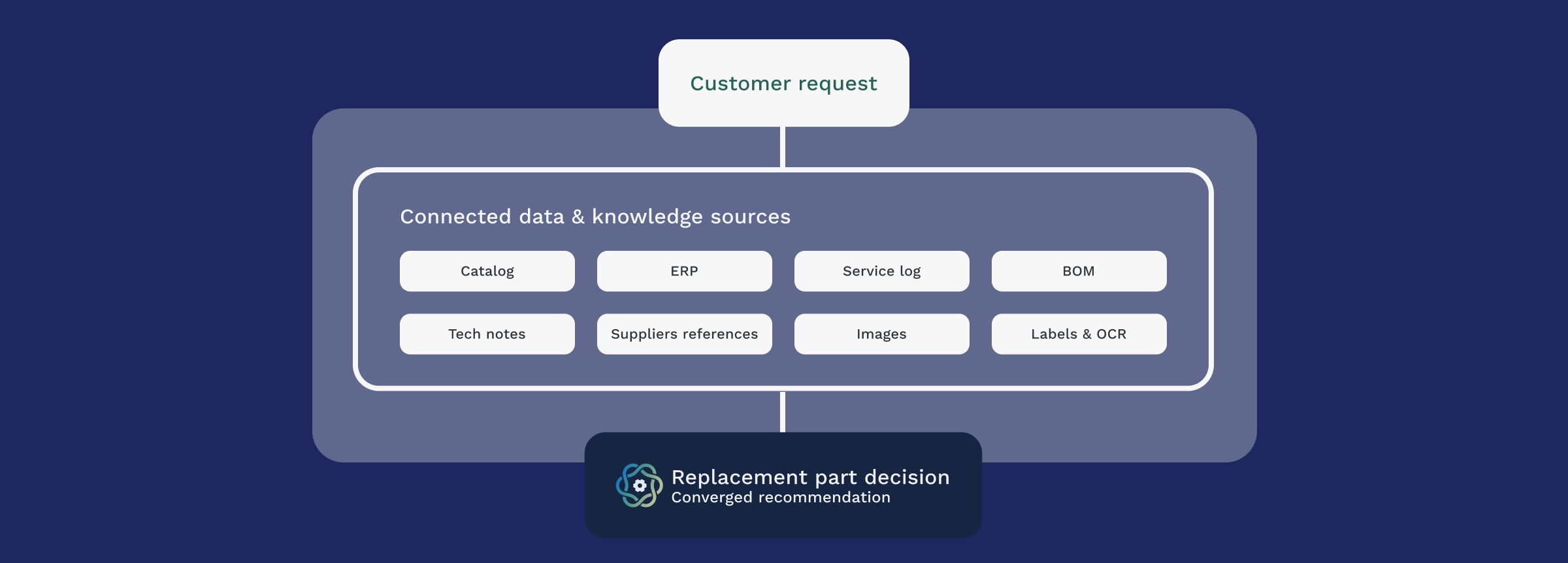
One of the biggest challenges in aftersales is that the answer may exist, but not where the service team needs it.
The part may be in the ERP.
The image may be in a catalog.
The service history may be in another system.
The BoM may sit somewhere else.
The useful knowledge may live with an experienced technician or parts specialist.
The supplier reference may not match the internal part record.
The replacement may exist, but under a different identifier.
From the customer’s point of view, none of that matters.
They do not care whether the delay is caused by the catalog, the ERP, the supplier reference, the service history, or a missing image.
They just experience the delay.
That is why aftersales teams need more than access to systems.
They need usable parts context.
They need to move from whatever the customer provides to the most likely part match, with enough confidence to quote, order, ship, or escalate.
That is a different problem than simple search.
Search assumes the user knows what to type.
Aftersales often starts before anyone knows the right term.
The cost of a wrong part is bigger than the part
A wrong part recommendation does not only create a return.
It creates friction across the service chain.
Someone has to process the return.
Someone has to find the correct part.
Someone has to explain the delay.
A technician may lose time.
A customer may wait longer.
A service relationship may weaken.
Revenue may move from “captured” to “at risk.”
In B2B service, reliability and predictability matter because customers depend on their assets to operate.
McKinsey’s research on aftermarket service expectations says industrial customers want reliability, availability, fewer unexpected costs, and less downtime from service providers. The same research found that quality, cost, and speed were the top three buying factors across every industry and region in its survey.
That is why the parts experience matters so much.
The customer may not separate the ordering experience from the service experience.
If the right part is hard to identify, the service feels slow.
If the wrong part arrives, the provider feels unreliable.
If the customer has to keep explaining the same problem, the provider feels disconnected.
If the team can identify the right replacement quickly from imperfect information, the provider feels capable.
In aftersales, speed matters.
But confidence matters more.
AI in aftersales should not start with a chatbot
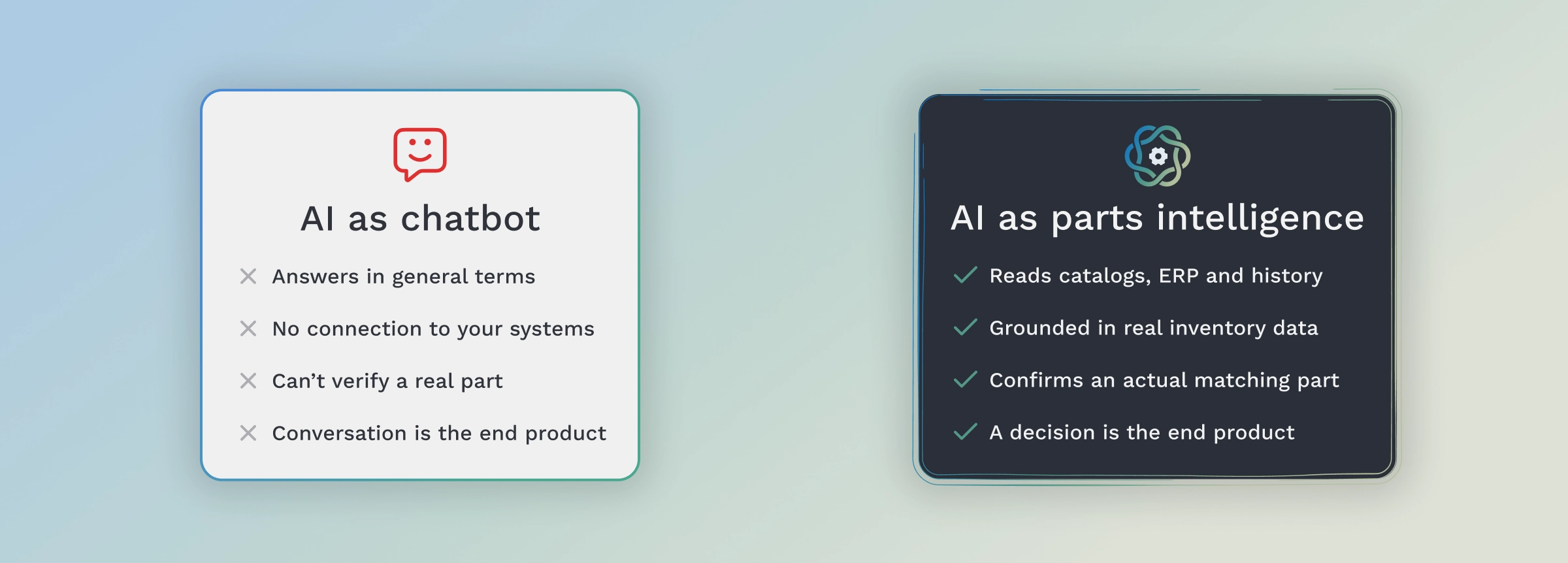
A lot of AI discussion in service starts with chatbots, virtual assistants, or automated customer interactions.
Those have a role.
But in industrial aftersales, the more important question is often deeper:
Can AI help the service team understand what the customer is actually asking for?
Because the hardest part of the interaction may not be writing a response.
It may be identifying the right part.
McKinsey’s aftermarket AI article says AI can help industrial and automotive companies scale expertise, anticipate needs, and deliver service with a level of speed and consistency that was previously difficult to achieve.
But for parts-heavy businesses, AI has to connect to the part workflow.
It has to help teams work with:
- photos
- worn labels
- scanned codes
- partial descriptions
- machine context
- BoM context
- old orders
- service history
- existing part knowledge
- supplier and manufacturer identifiers
That is where the opportunity is.
Not AI as a front-end gimmick.
AI as a way to help aftersales teams turn incomplete customer input into a better part decision.
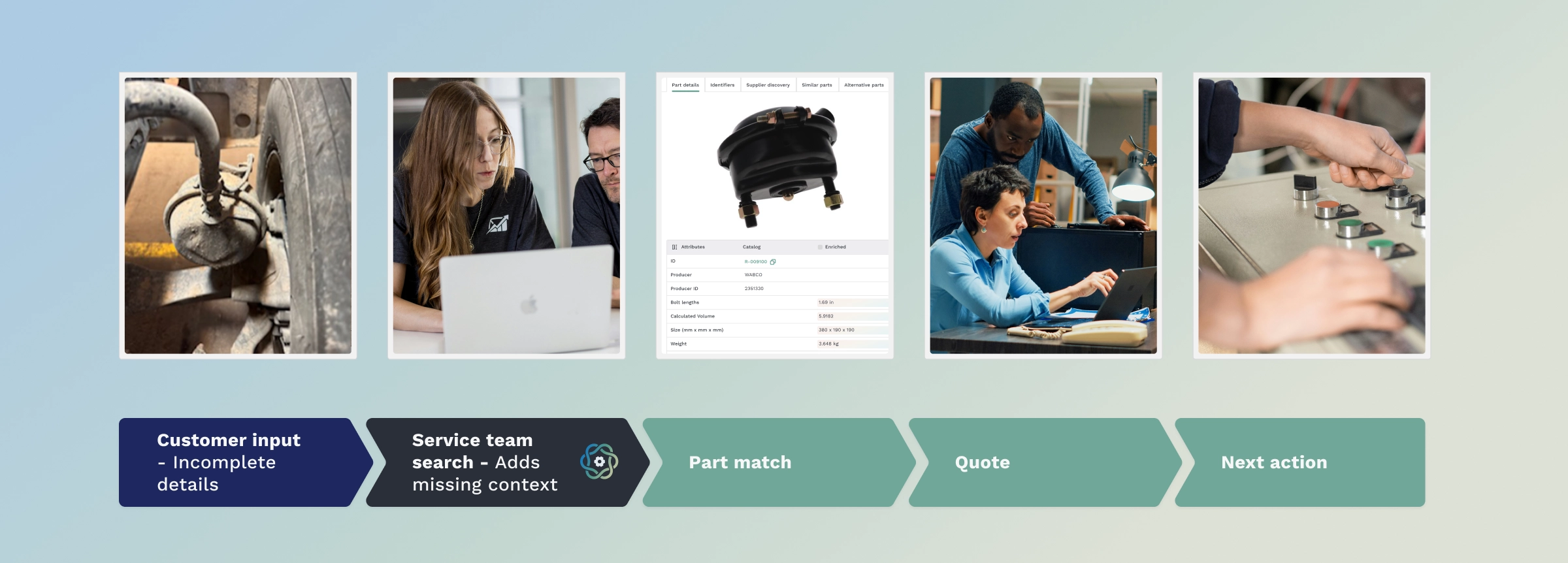
The story usually starts with partial information
Imagine a customer reaches out to a service team.
They do not have a part number.
They send a photo from the field and say the machine is down.
The label is dirty. The description is vague. The component looks similar to several other parts. The customer needs an answer quickly because the equipment matters to their operation.
In a traditional workflow, the service team may need to search multiple systems, ask a product expert, compare old records, check a catalog, or go back to the customer for more information.
That can work.
But it is slow, inconsistent, and dependent on whoever happens to know the answer.
A better workflow starts with the information available in the moment.
The image.
The visible label.
The equipment context.
The customer’s description.
The BoM.
The organization’s existing part knowledge.
That information should not live in separate silos during the customer interaction.
It should come together to help the service team identify the right part faster.
That is the idea behind parts intelligence in aftersales.
Parts intelligence turns service knowledge into service speed
Aftersales organizations already have knowledge.
The problem is that much of it is scattered.
Some lives in systems.
Some lives in catalogs.
Some lives in historical orders.
Some lives in technician experience.
Some lives in customer conversations.
Some lives in supplier data.
Some lives in product documentation.
Parts intelligence is about making that knowledge usable at the moment the service decision is being made.
For aftersales teams, that means:
- identifying the right part from imperfect customer input
- reducing back-and-forth
- helping service reps and dealers respond faster
- supporting customers who do not know the exact part number
- improving confidence before quoting or ordering
- reducing wrong-part recommendations
- protecting parts revenue
- improving the customer’s perception of service quality
This is not only operational.
It is commercial.
Aftersales revenue depends on the ability to serve the customer when they need help.
If the team cannot identify the part, the sale can stall.
If the wrong part is recommended, the relationship can suffer.
If the response is slow, the customer may look elsewhere.
The better the organization understands its parts, the better it can serve its customers.
Where Partium fits
Partium Find is built for this reality.
It helps teams identify the right part from the information available in the moment: a photo, label, code, partial description, filters, BoM context, or existing part knowledge.
For aftersales and service teams, that matters because customer requests rarely arrive in a perfect format.
The customer may not know what to ask for.
The service team still needs to help them get to the right part.
Partium helps turn that incomplete input into a digital parts search, so teams can move faster from customer question to relevant part match.
The goal is not just to make search faster.
The goal is to help the customer get the right replacement part with more confidence.
The future of aftersales is not just faster response. It is better understanding.
A fast answer is only useful if it is the right answer.
That is why the next phase of aftersales innovation should not be measured only by response time, automation, or self-service.
It should be measured by whether teams can understand the customer’s need earlier and more accurately.
Can they identify the right part from imperfect information?
Can they reduce the manual search behind every request?
Can they help less experienced reps perform more like experts?
Can they protect parts revenue by making the buying path easier?
Can they reduce returns and wrong-part friction?
Can they make the customer feel understood?
That is the aftersales opportunity.
Not just more automation.
More confidence.
Because in parts-heavy service businesses, the customer experience often comes down to one question:
Can you help me get the right part?